Table of content
Introduction to Recruitment
AI-Enhanced Recruitment
Data-Driven Recruitment
The Rise of the Gig Economy and Flexible Work
Focus on Employee Well-being
Diversity, Equity, and Inclusion (DEI)
Upskilling and Reskilling
Skills-Based Hiring
Internal Mobility
Candidate Experience
Mobile-First Recruitment
Conclusion
Introduction
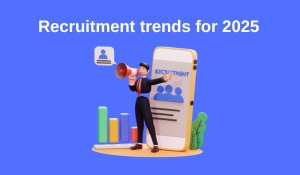
Recruitment is a field that is fast changing due to effects of technology, changes in workforce expectation, and global changes in the economy. Moving into 2025, companies who want to compete in the industry should also keep up with the changes to get and retain great staff. The hiring processes powered by AI, skills-based hiring, increase in focus on diversity, flexibility, and employer branding are just some of the ways the hiring processes of companies are changing significantly. The year will be a mixed year of innovation and adaptation and the winner will be the one who will be able to adapt to these changes in quickest time. Learn about the best trends that define the future of talent searching through 2025 and beyond.
AI-Enhanced Recruitment
In 2025, artificial intelligence changes the way the companies attract and assess the employees, quickly reinventing the hiring process. Interviewing AI is making the recruiting process more efficient by automating the process of viewing resumes, better matching of individuals, and using chatbots to do the initial interviewing and video analysis. Those innovations are time saving, biased free and allow more data based hiring practices. The AI will automate repetitive jobs and give recruiters the capability to engage in relationships and strategic planning.
By improving the hiring process in all aspects, AI is taking the hiring experience beyond predictions and into tailored personal experiences. The popularity of AI tools is becoming inevitable as organizations are forced to adapt to the competition in recruiting the best talent. In order to study this trend and develop expertise in this field, turn to the Artificial Intelligence Masters Program and be the part of the future of recruitment.
Data-Driven Recruitment
The use of data-driven recruitment is changing the game of organizations hiring through employing concepts of analytics and quantitative insights to achieve smarter hiring decisions. In the year 2025, businesses are using their data extensively to reduce the turnaround time, efficient flow of processes, and the quality of candidates. Whether it is to monitor the effectiveness of sourcing and application drop-off rates, or to analyze performance of interview and predict candidate success, all this is data driven.
By employing this practice, recruiters become less inclined to guesswork and prejudice and rather inclined to the number of metrics, such as skills match, cultural fit, and performance measures. Using dashboards and recruitment analytics tools, companies can have a clear idea of what does and does not work. In the new competitive talent market, the benefits of using data in recruiting are not optional but rather a tool to gain a strategic advantage to creating stronger and future-proof teams.
The Rise of the Gig Economy and Flexible Work
The trend in the workplace in 2025 is quickly changing as an increasing number of professionals want flexibility, autonomy, and work that is project-oriented. The rising trend of freelance and contract employment is challenging corporations to rediscover the conventional employment concept. The development enables organizations to rapidly grow, find specialized talent throughout the world and cut long-term expenses.
Simultaneously, employees are experiencing better working-life balance, autonomy and variety of career paths. Technology is a large part of the equation, where remote and hybrid teams can collaborate and work with ease. The gig economy and flexwork are critical in remaining competitive in business as companies adjust to this emerging normal. To develop skills to work in such a fast-paced world, consider an online course that helps advance the career such as RSA Archer Training.
Focus on Employee Well-being
By 2025, the importance of employee well-being is one of the key considerations that organizations take to increase engagement rates, productivity, and retention. Organizations are going beyond conventional health and wellness to embrace mental, emotional and societal wellness. Programs such as work flexible hours, employee mental health resources, wellness programs and massive emphasis on work-life balance are not exceptional any more.
Leaders are better trained to be able to identify the signs of burnout and nurture an inclusive environment. Technology can also assist this transition, and digital wellness tools and virtual supportive systems are important. The focus on well-being, in addition to improving employee satisfaction, is also necessary to result in long-term business success. In order to establish a healthy and strong and balanced career in tech, you can add on to your area of expertise by yourself by taking Cloud Architect Training.
Diversity, Equity, and Inclusion (DEI)
To become strategic priorities of organizations. Businesses are integrating DEI into their values, paying attention to establishing an inclusive environment where each employee can feel respected, valued, and empowered. In this form of inclusive and changing environment, professionals are upskilling with career-oriented coursework such as the Oracle APEX Training Course.
Some of them are transparent pay structure, hire free of prejudice, inclusive leadership development and understanding of unrepresented workforces. The businesses are also using the data to monitor progress and make teams accountable. The need to feel psychologically safe, appreciate cultural diversity, and representation of all levels now play a significant role when it comes to innovation and employee satisfaction. The powerful DEI culture will attract various talents and contribute to the cooperation and long-term achievements.
Upskilling and Reskilling
It is important to keep up with current developments in the job market by constantly learning and adjusting. The use of technology will change industries, and learned personnel must be ready to accept new positions and learn to operate new tools. Employees are being encouraged in many organizations to broaden their skills by highly focused learning programs that are aligned to business requirements in the future.
It may be the entry into a new area or reinforcing what one knows already, intensive training will enable individuals to be ahead of the game. Areas that are in demand such as in cybersecurity, cloud platform, and data analytics are particularly critical to career development. Industry-relevant and flexible learning routes are easing it faster than ever before. It is time to start a professional journey of growth with Upskilling on ArcSight a wise investment into your changing career.
Internal Mobility
Internal mobility is becoming a primary talent practice in most organisations that wish to develop and retain their employees. The companies are no longer considering the outside in recruiting talented persons instead of inside in developing persons and providing employees with the chance to shift along lines of roles and even departments or any other place. This not only allows saving the recruitment expenditures but also makes the employees more engaged, loyal and advancing in their profession.
Having access to learning platforms, being mentored and having a job board in the organization employees are better suited to find their way around, without having to leave the organization. Internal mobility is also an answer to businesses to react fast to changing priorities through redistribution of skilled work power where it may be needed. In a market where jobs are in abundance, promoting internally creates a culture of development, dynamism and sustainability within employees and business enterprise.
Candidate Experience
A positive and captivating hiring process needs to be created so as to be able to get and retain the most appropriate staff. The preliminary job search, the application, the interview, determines candidate views towards an organization. An open, polite and easy way to do this boosts the image of an organization. Conversely, poor communication, time taken or absence of feedback may also lose good candidates and tarnish the employer brand. In order to be different, companies are adopting simple application interface, frequent update and endearing customer interaction.
Those candidates who are not chosen have even more chances of reapplying in case they were treated well. You have more of a chance to create a lasting memory during your recruitment process in a competitive market and maintain a healthy talent pipeline. Additionally, to boost the potential of your team and mobility within an organization, you can choose to upskill your participants with online courses such as NetSuite Functional Training, a program that can train professionals and enable them to have the most sought-after ERP skills companies require today.

Mobile-First Recruitment
The job market is always mobile and employers need to move with it by moving towards mobile first recruitment. This strategy enables the jobseekers to access and apply to vacancies any time anywhere via the smartphones and tablets. The harmonious combination of career portals and application systems with mobile solutions will help organizations cover a wider range of talents, including the younger technotropic generation. Mobile-first recruitment also means a reduced response time rate, easier communication, and a more comfortable candidate experience.
Introducing mobile accessibility, companies not only make the process of hiring an employee more streamlined, but they also come across as more candidate-friendly and technologically savvy employers, thus, in line with the current workforce, moving to a digital environment. Organizations wishing to create a team prepared to the modern IT environments can also dedicate funds to SolarWinds Training, allowing them to acquire professionals, who will provide important skills in management of networks and systems.
Conclusion
With the ever-changing nature of talents, it is essential to keep up with the current trends in recruitment strategy to produce a versatile and forward-thinking workforce. Whether it is artificial intelligence-powered recruitment and decision-making, internal mobility, work flexibility, and the emphasis on DEI and well-being, 2025 is turning out to be an era of change in the way employers attract and retain employees. In organizations that adopt these changes in an agile and intentional manner, the resultant effect is not only an increased success in the recruiting process, but also on the employer brand, and satisfaction of the workforce. A strategic investment in the appropriate tools, strategies and skills development programs such as those provided by GoLogica can enable any business to construct a recruitment ecosystem that is disruptive, inclusive, and one that is long-term sustainable in a competitive global market.