

Introduction to financial management
Industry-Specific Needs
Manufacturing
Retail
Technology
Healthcare
Construction
Strategic Financial Planning
Cost Management
Risk Management
Financial Reporting and Compliance
Technology Adoption
Conclusion
Introduction
In all spheres of industry, financial management is one of the foundations of organizational success, as it is the strategy on which companies can model, allocate, and manage financial resources effectively. No matter which business it is, manufacturing or services or technology or any other business vertical, strong financial management based practices are a must to make it profitable, sustainable and ensure growth in the long-term.
In essence, financial management is a set of high priority processes which include budgeting, cash flow management, expense monitoring, risk analysis, and financial reporting among others. The processes enable organizations to optimize profits and remain liquid besides making healthy investment decisions. As an example, an appropriate budgeting technique would guarantee optimum installation of resources, whereas sufficient cash flow management would guarantee that companies are capable of covering the short term liabilities as well as acquiring growth opportunities when they emerge.
Today, financial management systems have gained even more significant importance, especially in the context of a digital economy, especially with the help of implemented integrated software systems, including ERP and CRM-based solutions. Such systems allow real-time access to financial information, operate efficiently, and assist in data-based decision-making. Through automation of repetitive processes and corporate consolidation of finance with other business activities, the organization minimizes the degree of manual errors, cuts operation expenses, and enhances productivity.
Further, industrial-specific issues involving compliance with the specific regulations in the healthcare sector or shifts in supply chain within manufacturing or a significant fluctuation in technologies in IT sector necessitate unique approaches to financial management. The end vision is however common across all sectors, yielding a robust and sound financial base that promotes operation agility and innovation upon which competitive edge can be achieved.
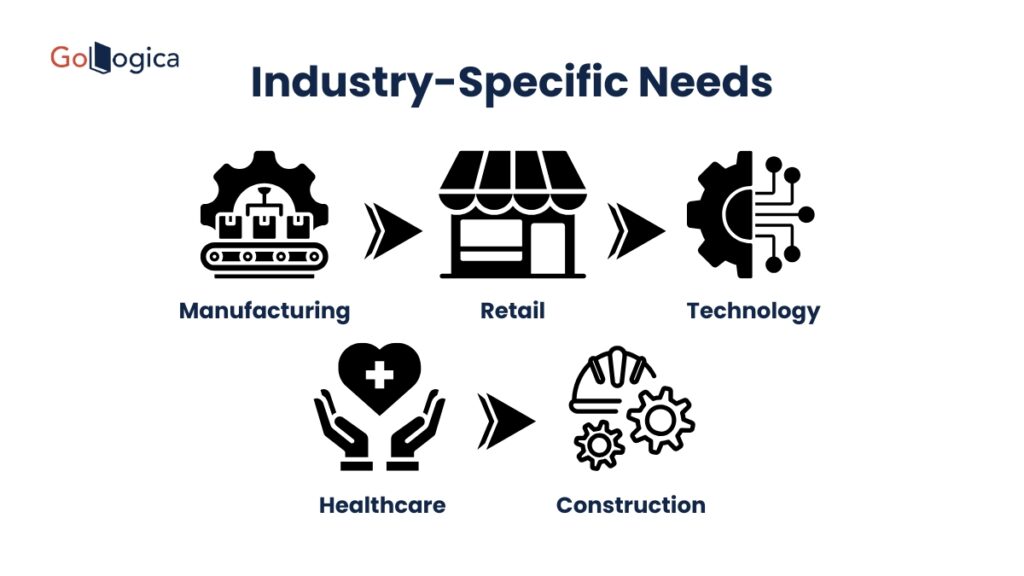
Industry-Specific Needs
Financial management in industries is critical in order to deal with the challenges and opportunities experienced by the industry. Financial management in the manufacturing industry is about minimizing the cost of production, addressing the fluctuation in supply chains, and utilizing online tools in order to monitor and budget the expenses in real time. One of the advantages of the sector is the inclusion of powerful analytics and automation so that working processes can be simplified and adjusted to varying tariffs and material costs.
Retail financial businesses deal with inventory management and cash flows, pricing, and profitability. An appropriate forecasting and budgeting and careful inventory management to avoid overstocks and stock-outs is also imperative. The retailers also need to be flexible to counterbalance the prices and cut on unwanted costs in order to retain the standard profit margins and play with changing needs of the customers.
The focus of financial management in the technology industry is set on investment research and development (R&D), accommodating high growth demands, and dealing with complicated revenue recognition, particularly of subscription-based products. Having alternative sources of income and utilizing fintech services can make tech companies competitive and flexible in conditions of uncertainty on the market.
Healthcare organizations focus on management of the revenue cycle, compliance, and cost control ensuring that they provide good patient care. Quality financial reporting, risk management and strategic technology investment are essential in terms of long-term sustainability and efficiency of operation.
The main concern of construction companies is the project-related budgeting, cost-control and risk mitigation. A clear reporting of financial figures and cash flow management will play a key role in the success of the project and the assurance of the stakeholders. Technology is important in automation of financial activities and ensuring upholding the industry standards.
Manufacturing
Effective management of finances is essential towards manufacturers who aim to be competitive in the fast changing world. Financial strategies in the manufacturing environment need to deal with varying raw material prices, hitching in the entire supply chain, and intricacies of the production chain. Having a firm budgeting process by which resources are allocated effectively is at the center of success in terms of allocation of resources in terms of procurement, labor and capital expenditures. Manufacturers enjoy real-time cost monitoring and analytics to quickly change the prices and business operations strategies according to the changes on the market.
Another critical area that should be considered is the management of cash flow because manufacturers usually experience delays between the production of goods, their storage in the warehouse, and their sale. Liquidity helps the manufacturers to settle short-term liabilities and invest in the innovation. Moreover, the transformation of the advanced financial management systems, including ERP software, will allow simplifying the accounting, management of stocks, and reporting processes, minimizing the charges and enhancing efficiency.
Retail
Financial management is important in retailing to promote the smooth operation of the fast-paced competitive industry. Best practices involve very broad spectrum of operations including but not limited to budgeting, forecasting, inventory management and cash flow optimizations. Retailers have an interest in the maximization of revenue and that they need to maintain costs and as such they have to find the balance to enable them to deliver upon the demands of operation and at the same time ensure profitability.
Especial importance is given to the management of inventories that can lock away capital when excess supplies are received or result in the loss of business and customer dissatisfaction once inadequate supplies are available. The management of the cash flow is also vital so that the retailers can meet the costs, make investments and act to changes in the market. The pricing model should be dynamic and should consider the demand and the competition to ensure good profits.
Technology is a revolutionary force that entails real time analytics and automation, which streamlines the financial process and enables data driven decision-making. Implementing such strategies as the establishment of clear financial objectives, frequent performance reviews, and innovation will help retailers create a stable background to face the long-term evolution of the market.
Technology
Financial management in the technology industry is a valued process that helps to spur swift innovations in practices and expansions in a highly competitive business environment. The situation in tech companies (particularly startups and providers of SaaS) is more complicated: these companies face the need to spend financial stability carefully on research and development (R&D), human resources, and infrastructure developments. Revenue recognition is an independent issue and becomes a challenge especially to subscription-based models, where it should be accurately with exact accounting and prediction to provide correct reporting of the financial dealings.
Management of the cash flow is essential, since technology companies, at times, experience prolonged development time, prior to instituting massive revenues. Proper budgeting assists in a balance between operations and long-term strategy investment. Moreover, innovative financial tools and analytics allow tech companies to track their performance, optimize the use of pricing instruments and spot new sources of income.
Through automation and cloud-based financial platforms, technology companies can automate workflow and minimize mistakes and obtain real-time information. However, at the end of the day, best financial management can make tech firms respond to changes in the market, attract investors and ensure continued expansion, and the generation of new ideas.
Healthcare
Financial management plays a significant role in healthcare as it ensures the organization provides quality care services to patients and at the same time sustains organizational stability. The providers of health services are dealt with by unique challenges such as managing complex revenue cycles, regulatory compliance, and containing escalating costs of operations. High levels of billing, frequent processing of claims, and a well-rounded accounts receivables management are necessary to keep the cash flow constant and reduce the number of delayed payments.
Healthcare organizations also have to invest in technology- i.e. electronic health records (EHR) and financial management systems so as to automate administrative tasks, giving more accurate data and cost-cutting. Budget planning and cost management are very important since they assist in the proper distribution of resources within the clinical practice, employees, and equipments.
As well, there is risk management because healthcare providers should be ready to cover unpredictability of reimbursement policy or patient potential numbers. Healthcare organization can achieve operational efficiency by ensuring compliance and maintaining quality standards of care its patients expect by following best practices in financial management.
Construction
Financial management is a key factor which determines the survival of construction firms. High upfront expenditures, resources and timing, and erratic cash flow are also key features of this type of industry characterized by large-scale projects. Since the construction of any project requires budgeting, construction companies have to maintain a proper control of project-based budgeting and at the same time cost each of the phase of the construction process; its planning, procurement, labor and materials among others.
The use of cash flow needs a special consideration because even without payment delays by a client or unplanned costs, operations are soon to be affected. Contracting companies have to make sure that they have ample liquidity to take care of the payroll, equipment hire, and contractors. It is also important to mention risk management as during the execution of the project, unexpected situations like weather or supply chain might occur, resulting in the increased cost of the project and its delay.
Utilization of the technologies, including construction software and system accounting, can contribute to the streamlining of the financial processes and better transparency. Incorporation of good financial strategies in the construction industry enables companies to increase profitability of projects, gain the trust of clients and increase sustainability in this competitive business world.
Strategic Financial Planning
Strategic financial planning is hence an important process that allows organization to match their financials with long term business goals hence the stability and growth. Such an approach combines an overall strategic outlook and management of financial and more aspirational objectives and goals.
Essentially, strategic financial planning entails setting up very specific, quantifiable objectives, i.e. revenue targets, market expansion, and so on. Organizations then check their standing on the financial health, touching on assets, liabilities, cash flow and capital structure in order to know where to begin. The analysis can be used to come up with viable actions and measures such as budgeting, forecasting, and capital allocation, to help make the best out of what is available and get the future needs in advance.
The other important element is risk management, which aids the businesses in identifying, evaluating, and eliminating the financial uncertainties in case they are produced by the market, regulatory, or operational shocks. Constant review and revision of financial plans results in the companies being agile, as they keep up with changing situations in maintaining the pace of their strategic plans.
Finally, strategic financial planning enables the organization to make reflective decisions, ensure that it gets the absolute returns on the investments and establish a solid platform with sustainable success- regardless of the industry and economic cycles. Within them all incorporated in their operation, businesses will be able to traverse the complexity, capture the opportunities and become long-term sound financially.
Cost Management
Cost management is one of the core business processes which enables organizations to plan, to monitor and to control costs during each stage of a project lifetime or companywide. Fundamentally cost management encompasses direct cost (the cost of materials, cost of labor etc) as well as indirect costs (cost of overheads and administrative expenses among others) identification, estimation, and tracking. With this thorough comprehension of such costs, enterprises will be able to form feasible budgets and make definite standards to measure performance.
The concept of good cost management is more than drawing on ways of reducing costs ultimately, but rather bringing out the best in terms of utilization of resources in order to ensure that value has been delivered to the maximum and advocacy of quality and operational elements is not compromised. It entails making predictions about future expenses using the historical records and comparing the actual prices with the plans in real time and assessing variance in order to take corrective measures where there are variance levels. The above systematic monitoring assist organizations to exercise financial discipline, waste reduction, and improved profitability.
Also, cost management is part and parcel of strategic decision-making. It also equips the management with the right and up to date information that it can use to make the right decisions on how to allocate resources, set prices and investment decisions. In all the industries, the specific application of cost control strategies focuses on unique issues like the dynamic nature of supply chain in the manufacturing industry to the compliance to regulations in the healthcare industry, the common element here is a pursuit of greater efficiency and competitive advantage. One final illumination of the cost management practices is that strong cost management practices enables an organization to pursue sustainable growth, operational excellence, and long-term financial prosperity.
Risk Management
Risk management is a procedural process that helps organizations to determine, evaluate, rank higher and reduce threats that may affect the organizations goals, performance, or stability of the company financially. The business world is highly complex and dynamic nowadays, and thus risk management is the prerequisite in terms of protecting assets and assuring operation continuity and longer-term development.
The first stage is risk identification in which companies examine the internal and external environments to unveil potential risks, which can include financial uncertainty and fluctuation in the market, changes in regulation, technological upheavals, and operational risks among others. Having identified them, risks are evaluated based on their probability and possible impact, and business will be able to understand its risk portfolio and what risks have to be dealt with now and which ones can wait to be handled.
Then mitigation strategies are to be worked out and possibly they entail the risk avoidance, reduction or transfer (like insurance) or its acceptance. Continuous monitoring and reviewing are also important because new risk may arise and old risks may change with time. Successful risk management cultivates a culture of cautiousness and readiness and enables organizations not only to overcome challenges but also to embrace opportunities at a very fast rate.
There exist industry-specific risk management strategies that go into the sensitivity of the activities of various industries, say, supply chain risks in manufacturing, cybersecurity threats in technology or compliance risks in healthcare. In conclusion, risk management can be incorporated in the strategic planning and organizational operation in order to make organizations resilient, safeguard the interests of stakeholders, and realize sustainable success in the uncertain world.

Financial Reporting and Compliance
Compliance and financial reporting form the very core of the operations of a modern business and allow everyone to be transparent, responsible, and trustworthy of one another. Financial reporting is the organized processing of the financial reports, including balance sheets, income statements, and cash flow statements that precisely signify the financial states and performance of companies during particular times. Such reports apart from being essential to internal decision-making process they are also an essential source of information to investors, regulators and the society as they only provide essential data needed to determine the going aboutness and growth potential of a company.
Compliance on the other hand is that the financial reporting and disclosure should be strictly followed by the laws, regulations, and accounting standards. Organizations in the U.S use Generally Accepted Accounting Principles (GAAP), whereas overseas companies could adopt International Financial Reporting Standards (IFRS). These standards are implemented by regulatory authorities like the Securities and Exchange Commission (SEC) to avoid misrepresentation of the finances and the integrity of the market. The issue of compliance has great importance in terms of escape of legal fines, faithfulness to investors and preservation of corporate status.
In combination, effective financial reporting and compliance procedures give rise to the culture of business transparency and ethical practices. To eliminate mistakes and frauds they need to be appropriate by possessing quite solid inner controls and periodically controlled by audits and frequent monitoring. In the end, these are practices that make an organization make informed decisions, investment-attractive, and sustainable in a highly complicated and ever-changing regulatory environment.
Top Finance Management jobs for 2025
Technology Adoption
Adoption of technology is a game changer in most sectors and this has enabled institutions to improve efficiency, become innovative as well as keep them competitive. The incorporation of contemporary digital means like cloud computing, artificial intelligence, and automation enables businesses to operate more efficiently, uncouple human labours and enhance decision-making by relying on real-time data analysis. Within manufacturing, retail, healthcare, and construction industries, technological implementation allows managing the resources better, optimizing supply chains, and conducting remote work.
Adoption of technology also helps in complying and managing finances since the reporting will be done automatically and the errors will be minimized. But the adoption effort should be well-planned, train the employees and manage the changes to break the resistance to harness the maximum benefits. After all, the emphasis on technology adaptation helps organizations to be prepared to implement the change in the market, operate and satisfy their customers and eventually realize growth in the long-term in the growing digitized world.
Conclusion
The management of financial resources is one of the stepping stones in the operation of any organization in any industry, this is the underlying strategic framework that puts any organization in a better position to plan, allocate, and manage financial resources in an effective manner. In this regard, a combination of financial management practices is necessary regardless of the nature of the enterprise one operates be it manufacturing, services, technology, and any other kind of business to warrant profitability, sustainability, and future expansions.
Fundamentally, financial management refers to a package of essential operations, such as budgeting, cash flow, expense controlling, risk management, and financial reporting. These are the processes that enable organizations to make the most profit, stay liquid, and enable sound decisions involving investments. As an example, good budgeting implies the allocation of resources in the best possible way and good cash flow management means that the businesses are able to finance their short-term commitments and the ones that their business growth prospects present on the spot.
Use of financial management system, which is mostly fuelled by integrated software tools like enterprise resource planning and customer relations management tools, has also become a matter of essence in the current digital age economy. Such systems will offer real-time insights of financial data, decision-making with ease of operations as well as a decision-based approach to decision-making. Automatizing routine activities and by harmonizing finance with other business activities, companies can decrease the amount of manual errors that can occur, cut down on the cost of operation as well as boost efficiency.