Table of Contents
Introduction
Why Digital Skills Are Essential in 2026
Mastering the Top 10 Digital Skills
Industry Applications and Impact
Continuous Learning Strategies
Technical vs. Soft Skills Integration
Future Trends in Digital Proficiency
Career Opportunities & Salary Insights
Conclusion
Introduction
The 2026 signals an obvious shift in the sphere of professional advancement, when digital competencies become the currency of all professional success. With the future of any industry being transformed by artificial intelligence, cloud computing, data analytics, and cybersecurity, people who can excel in all of these skills have a competitive advantage that is directly reflected in their compensation, employment stability, and accelerated career advancement.
It is no longer required that businesses seek generalists, but experts, who are able to leverage technology to inspire innovation, streamline the business, and address difficult issues.
The guide has described the value of being digitally proficient and then dealt with the ten top skills to grasp, how they are changing every industry, how they can be learned, the kind of equilibrium needed between technical and soft skills, future trends, and the fact that digital experts could be in high demand next century.
As a new graduate, as a mid-level worker who is looking to move on, or as an industry veteran facing the transition to digital first, this road map will get you ready to succeed in the digital-first economy in the future.
Why Digital Skills Are Essential in 2026
Digital skills have transcended their status as optional technical knowledge to become the fundamental requirements that distinguish high-performing professionals from the rest. Recent industry reports reveal that 92% of all job postings now explicitly require digital competencies, with employers prioritizing candidates who demonstrate proficiency in AI, data analytics, cloud platforms, and cybersecurity. This shift reflects the broader reality that businesses leveraging digital technologies achieve 2.5 times higher revenue growth and 3 times greater profitability compared to their less digitally mature competitors.
For individual professionals, the benefits are equally compelling. Digital fluency commands salary premiums of 25-40% above industry averages, provides resilience against automation-driven job displacement, and enables unprecedented career mobility across sectors and geographies. In an era where 85 million jobs may be automated by 2025 while creating 97 million new digital roles, those equipped with the right skills position themselves at the forefront of opportunity. Digital proficiency empowers you to automate repetitive tasks, derive actionable insights from complex datasets, lead digital transformation initiatives, and make data-driven strategic decisions that deliver measurable business value. Ultimately, digital skills don’t just enhance your resume, they redefine your professional identity and future potential.
Mastering the Top 10 Digital Skills
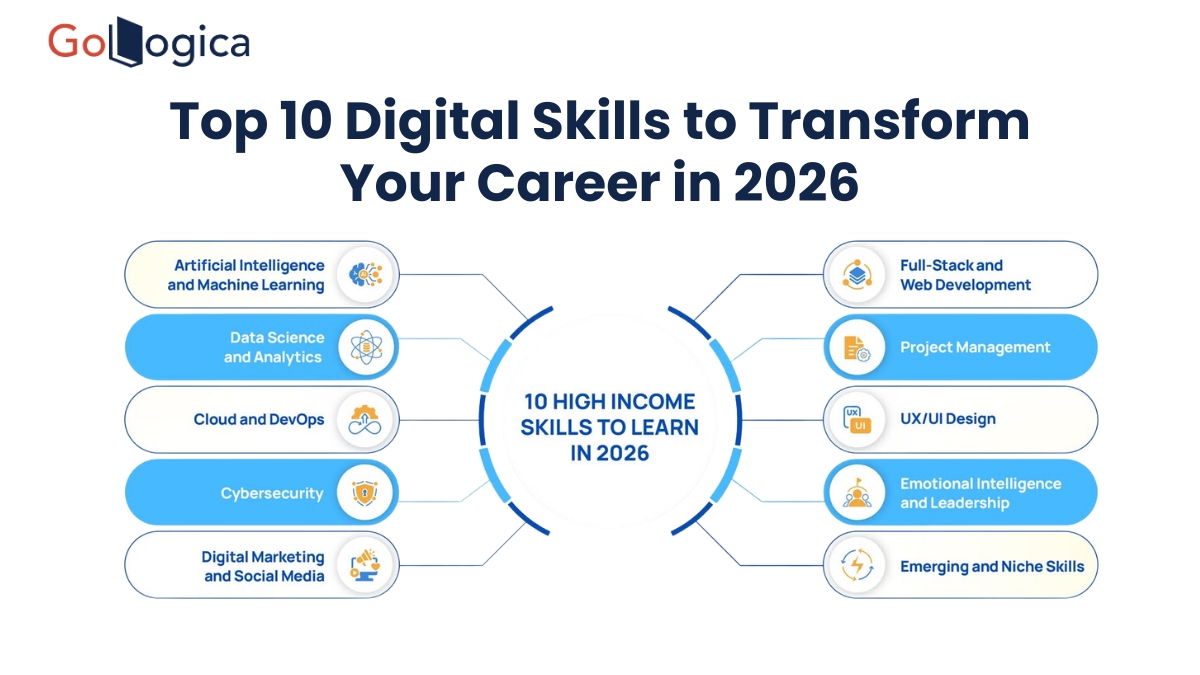
Success in 2026 demands targeted mastery of these essential digital competencies, each backed by surging market demand and tangible career benefits:
Machine Learning (ML) and Artificial Intelligence (AI).
AI/ML professionals develop software that employs data to make automatic decisions and forecast outcomes, and be able to optimize processes. Its basic software includes Python, Mathew TensorFlow, PyTorch, scikit-learn, and Jupyter notebooks. Its applications are as recommendation engines, such as Netflix, fraud detection in banking, predictive maintenance in the manufacturing industry, and autonomous vehicles.
Data Science and Analytics
Raw information has been converted into strategic value by the data scientists. They use SQL to query databases, work with data in Python (Pandas, NumPy), and do statistical computations in R, interactive visualizations in Tableau and Power BI, as well as quick prototyping in Excel and Google Sheets. Major areas of concern include customer segmentation, market prediction, optimization of operations, and performance benchmarking across industries.
Cloud Computing
AWS, Microsoft Azure, and Google Cloud provide the opportunity to construct scalable infrastructure by architects. Depending skills include Infrastructure as Code, Terraform, and Cloud Formation; container orchestration using Docker and Kubernetes; serverless computing using Lambus as well as hybrid or multi bringing the cloud solutions that ensure greater resilience at a lower cost.
Cybersecurity
The security professionals defend the digital assets by intelligences of threat, vulnerability evaluation, and ethical hacking (CEH). They operate through SIEM such as Splunk, intrusion detection software such as Wireshark, and adhere to such frameworks as GDPR, NIST, and ISO 27001. These skills are highly salaried with the cost of cybercrime on a routine basis estimated to cost at least 10.5 trillion every year by 2025.
Software Development
Full stack developers are the ones that build up end to end applications. Front-end Web sites are React, Vue.js, and Angular: back-end stacks are Node.js, Django, and Spring Boot. MongoDB, PostgreSQL, and MySQL are various types of databases, and DevOps is characterized by the use of Git and CI/CDs pipeline. The knowledge of RESTful APIs, microservices, and responsive design will create flexibility in the web, mobile, and enterprise solutions.
Project Management
Digital project managers facilitate complicated initiatives by applying Agile, Scrum, and Kanban. Sprint planning, backlog grooming, risk management, stakeholder communication, and roadmap creation are also assisting with the use of tools, such as Jira, Trello, Asana, Microsoft Project, and Monday.com to keep projects on time and budget.
Digital Marketing
The marketers promote acquisition and retention using SEO, PPC advertising (Google Ads) and content marketing, social media strategy (LinkedIn, Instagram, TikTok), email automation (Mailchimp, HubSpot) and analytics (Google Analytics 4, Adobe Analytics). These strategies provide quantifiable ROI.
Business Analysis
Business analysts mediate technology and business objectives by conducting requirements gathering, processes modeling (BPMN, UML), use-case development, conducting stakeholder interviews, and the evaluation of the solutions. Visio, Lucidchart, Jira and Confluence are tools that assist in the documentation and management of requirements.
UI/UX Design
One of the approaches used to create a user-friendly experience by UI/UX designers is through user research, wireframing, prototyping (Figma, Adobe XD, Sketch), usability testing, accessibility standards (WCAG), and A/B testing. Their work is a balance between user pleasure and commercial purposes.
Agile and Scrum
Practitioners of the Agile/Scrum model make it possible to facilitate iterative delivery through daily stand-ups, sprint planning, retrospectives and backlog refinement, and velocity tracking. Such certifications as PSM, CSPO, and SAFe Agilist are proven documents on proficiency in adaptive and value-oriented project development.
Industry Applications and Impact
The digital skills are driving change of monumental results in key areas:
Healthcare Transformation
AI diagnostic algorithms are capable of detecting such conditions as diabetic retinopathy with 94 per cent accuracy. Telemedicine on clouds provides services to millions of people in remote regions. Predictive analytics reduce hospital readmissions 30 0 – it saves billions annually.
The Revamp in Financial Services.
Machine-learning can detect a fraudulent transaction in milliseconds with an accuracy of 99.9. An up to $6 trillion of cyber-crime loss on the annual cybersecurity frameworks is guarded. Blockchain provides safe and transparent international payments.
E-commerce and Retail: The Development.
With hyper-personalized marketing, digital marketing produces 15x ROI. During Black Friday, the traffic spikes are 10 times greater than the normal traffic volume, which is managed by cloud infrastructure. Optimization of UI/UX increases the conversion rates by 200400 percent.
Manufacturing Modernization
In combination with ML, IoT sensors forecast the maintenance requirements, and the quantity of unexpected downtime is decreased by half. Digital twins enable units to conduct virtual examples of open production lines. Agile strategies reduce the product development time to months.
Education Innovation
Learning environments improve content retention through adaptive learning by a factor of 2.3. Skills training VR/AR simulations offer an immersive training. Analytics in data help monitor the progress of students and provide specific intervention.
Logistics Optimization
With the help of real-time route-optimization algorithms, fuel-costs are decreased by 20%. Stockouts are averted through supply-chain visibility dashboard. Computer vision drone delivery brings last-mile efficiency.
These uses show that the digital skills are strategic multipliers, which contribute to increasing revenue, reducing costs, and creating differentiation.
Continuous Learning Strategies
Digital mastery demands lifelong commitment through structured approaches:
Certification Pathway: Develop strong projects on either GitHub, enter Kaggle data-science-contests, volunteer on an open-source-project and get a side-gig authentically through Upwork and Fiverr to experience the benefits of working with real clients.
Practical Proficiency: Develop production-quality portfolios in GitHub, solve Kaggle problems, open source projects, and contract work through Upwork / Fiverr to get a hands-on and have a client of your own.
Community Engagement: Participate in LinkedIn learning communities, become members of subreddit communities related to learning programming on Reddit, participate in Stack Overflow, and local tech meets. Go to conferences like AWS Invent, Google Cloud Next and black hat conferences.
Microlearning Integration: Take 10 -15 minutes lessons every day, either through YouTube (e.g., freeCodeCamp and Traversy Media), podcast (e.g., Software Engineering Daily and Syntax), or newsletter (e.g., TLDR Tech and Hacker Newsletter), or through apps on your phone (e.g., SoloLearn or Mimo).
Mentorship Acceleration: Participate in MentorCruise, GrowthMentor, or other corporate mentorship programs. Stay up to date on new platforms by reverse mentoring Gen-Z digital natives.
Structured Roadmaps: Attend a 90-day course consisting of 60-percent practical, 30-percent theoretical and 10-percent networking in an actual plan to achieve quantifiable improvement.
Technical vs. Soft Skills Integration
Technical Skills (Hard Skills) are task specific, measurable and are required to perform specific job tasks or utilize special tools and technologies. They exhibit what you do and know in your position.
Soft Skills are interpersonal and behavioral skills that define the degree of effectiveness in relating with other people, adapting to situations, and approaching challenges. They are how you work and work together.
Key Differences
Technical Skills: Task and job (coding, analysis of data, software)-related.
Soft Skills: Global and other people (information, teamwork, leadership)
Acquisition Method
Technical Skills: These are mastered by way of training, courses and certification and practice.
Soft Skills: Developed through Life experience, feedback, mentorship, and self-consciousness form the basis of these skills.
Measurement
Technical Skills: Measurable through tests, works, certifications and through performance measurement.
Soft Skills: Evaluated using observation, behavioral interview and 360 feedback.
Transferability
Technical Skills: Have to be similar positions or industries.
Soft Skills: Cutting across jobs, industries and career development stages.
Career Impact
Technical Skills: Get you hired and prove job competency
Soft Skills: Cutting across jobs, industries, and career development stages.
Why Both Matter: Studies indicate that 85 percent of the successes in careers are caused by soft skills, and 15percent of the successes in careers are caused by technical ability. The best employees create a perfect blend of both technical skills that land you there and soft skills that make you stay on top.

Future Trends in Digital Proficiency
Trends redefining skill requirements 2026-2030
Generative AI Proliferation: The emerging tools, such as GPT-5 and DALL-E, generate code, produce content, and generate graphics. They require immediate engineering, fine-tuning of models, and ethical putting into purpose understanding.
Edge Computing Dominance: Intelligence is executed within data providers, like IoT devices, enabled by 5G. Distributed systems design, real-time analytics, and low-latency architecture will become the keys to success.
Zero Trust Architecture: ANWR: Never trust, ever verify. There are no perimeter defenses anymore: professionals must learn to master identity and access management, as well as micro-segmentation.
Digital Twin Ecosystems: Simulation: Virtual proxies Virtual proxies are used to manufacture, simulate healthcare, and plan cities. These professions demand 3D modeling, real-time synchronisation, and predictive-simulation abilities
Sustainable Computing: Green cloud, AI that is energy-efficient, and infrastructure that is carbon-conscious can support green environmental aims.
Web3 and Decentralized Applications: Web3 and some blockchain Come to be ready to build on blockchain, create and operate smart contracts, operate and oversee decentralized applications, comprehend token economics to operate successfully in the creator economy.
Multimodal AI Systems: : The future systems will work concurrently on text, image, voice and video, introducing more human-machine interfaces.
Quantum-Resistant Cryptography: Prepare to have an impact of quantum threat on existing encryption systems.
Career Opportunities & Salary Insights
Digital mastery unlocks premium compensation across high-growth roles:
| Role | Global Salary Range | India Salary Range | Projected Growth | Key Industries |
| AI/ML Engineer | $130K-$220K | ₹25-60LPA | 40% | Tech, Finance, Healthcare |
| Data Scientist | $120K-$180K | ₹18-45LPA | 35% | All Sectors |
| Cloud Solutions Architect | $140K-$200K | ₹20-55LPA | 32% | IT, E-commerce |
| Cybersecurity Architect | $120K-$170K | ₹18-50LPA | 31% | Finance, Government |
| Full Stack Developer | $100K-$160K | ₹15-40LPA | 25% | Tech Startups |
| Digital Marketing Director | $110K-$160K | ₹20-45LPA | 28% | Retail, Media |
| Senior UI/UX Designer | $95K-$145K | ₹12-35LPA | 27% | Product Companies |
| Technical Project Manager | $105K-$155K | ₹18-42LPA | 26% | Consulting, Tech |
Entry-level digital roles pay 25-35% above traditional positions with rapid progression trajectories.
Conclusion
Make continuous learning your lifelong advantage. The GoLogica Professional Certificate Program in Artificial Intelligence and Machine Learning offers the of expert-led instruction, 15+ real-world projects, AWS/Azure cloud deployment training, and globally recognized certification that propels graduates to top industry salaries.
Digital skills are your ultimate competitive edge in the 2026 dynamic professional landscape. Mastering AI/ML, data science, cloud computing, cybersecurity, software development, project management, digital marketing, business analysis, UI/UX design, and Agile/Scrum while cultivating essential soft skills like communication, leadership, and adaptability positions you for extraordinary career acceleration, financial independence, and industry leadership.
The digital future favors the prepared. Don’t wait for opportunities, create them. Enroll today in GoLogica comprehensive AI/ML program and transform your professional destiny. Lead tomorrow’s innovation revolution starting now.