
Table of Content
Introduction to Employee Training
Employee Training Tools for Upskill
Learning Management Systems (LMS)
Content Authoring Tools
Micro learning Platforms
Virtual Classroom Software
AI-Powered Content Generation
Knowledge Base Platforms
GoLogica provides Online Training Courses for Upskilling
Conclusion
Introduction
In the fast-paced business of the present world, continuous learning is essential in order to stay ahead in competition. Upskilling workers has also turned into a strategic necessity with fluid organizations to enhance productivity, bridge skills gaps, and fuel innovation. Employee training tools are essential in facilitating effective, scalable, and engaging processes. From Learning Management Systems (LMS) and E-Learning solutions to simulation and micro learning software, current tools are offered in diverse solutions that can cater to varying learning needs. The tools facilitate employees to learn at their convenience since they allow organizations to track development and measure impact in an efficient manner. Here, we examine the best employee training solutions that can help your employees stay competitive in a rapidly changing world.
Employee Training Tools for Upskill
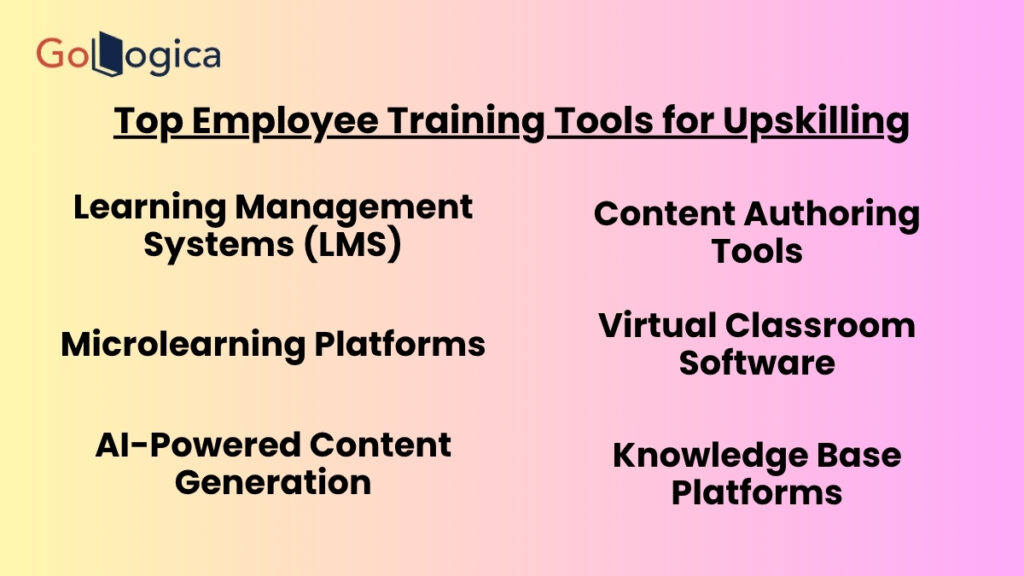
Upskilling is no longer an option in our evolving world of work today—it’s the requirement. In order to compete with the new technology and shifting business demands, organizations must put money into successful training mechanisms for employees. Not only do these improve workforce competency, but they create continuous learning as well as professional development. From Learning Management Systems (LMS) automating the delivery of training to Content Authoring Tools to enable the creation of customized courses, there are countless choices. Microlearning Platforms deliver bite-sized, focused content to busy professionals, and Virtual Classroom Software delivers interactive learning in real-time. AI-Powered Content Generation is revolutionizing the creation of training materials, and Knowledge Base Platforms make company resources centrally accessible. In this, we determine the best possible tools for employee upskilling and how to drive productivity, engagement, and development.
Learning Management Systems (LMS)
An LMS is a computer program used to manage, deliver, and monitor instruction material and training courses. It is a site where instructors upload courses, distribute activities, administer tests, and review student work. An LMS provides the students with access to content anytime and anywhere for self-study and continuous skill development.
LMS software is also utilized heavily in academic institutions and corporate environments, as well. In academic institutions and schools, platforms like Moodle or Blackboard allow instructors to create compelling content, collaborate, and auto-grade. In business locations, companies utilize LMS software like TalentLMS or SAP Litmos for onboarding, compliance training, and professional development.
For example, an international business can roll out a fresh cybersecurity training module to workers at foreign offices by using an LMS. An LMS offers consistency of material and tracking in real time for monitoring purposes of engagement and rate of completion. By using an LMS, organizations and institutions can achieve optimized learning attainment, save time, and reduce training costs while maintaining learning scalability and measurability.
Content Authoring Tools
Content Authoring Tools are computer applications that make the work of designing, development, and publishing learning materials in digital forms easier. They play an essential role in e-learning, corporate training and education based activities by providing simple methods of building interactive and engaging content in the form of quizzes, videos, simulations, and tutorials without strong programming skills. Their user-friendly interface makes it easier to guide instructors and instructional designers to create flawless and professional training material consistently.
Another example can be seen in the iSpring Suite a PowerPoint based authoring tool that can convert PowerPoints into interactive e-courses. As an example, an employee orientation presentation can be converted by a healthcare organization into an interactive course using iSpring to include voiceovers, assessments, and real-life situations. It can then be loaded onto an LMS to be accessed easily and tracked.
Some other popular tools are Adobe Captivate, Articulate Rise, and Lectora. These tools and platforms allow functions like adaptive design, gamification, SCORM/AICC integration, and real time collaboration, which makes these solutions perfect in a modern and mobile-friendly environment.
Microlearning Platforms
Microlearning platforms are online applications that are used to provide users with bite-sized, concentrated learning opportunities that are focused on a particular skill or body of knowledge. These channels cater to the immediate demand of the contemporary student to have easily consumable content that is very easy to digest with the average time being mere minutes. Microlearning is perfect when you are a busy and want to learn in-between, touch-up on something you have learned or close a gap in knowledge that you have, but do not need to pursue a long-term course.
Among the best examples is EdApp, the mobile-first microlearning platform that enables organizations to develop interactive, bite-size lessons and share them with their team. As an example, a business that sells goods can introduce a training program on the new capabilities of one of their products with the help of EdApp, to accomplish this within 5 minutes of each other, creating a visceral experience, allowing participants to keep up with the latest developments in their products. Such format increases interaction and retention along with application of the material on the job.
Other common microlearning solutions are Axonify, Grovo, and TalentCards that feature such capabilities as gamification, monitoring progress, and accessibility via a mobile device. These platforms are usually connected with Learning Management Systems (LMS) and performance-analytical system that helps to get continuous learning and monitor performance.
Virtual Classroom Software
Virtual Classroom Software is a program which offers a tele-interactive web-based training space that educators and students are able to visit concurrently. It is an online simulation of a physical classroom since it provides the following capabilities: video conferencing, digital whiteboards, chat capabilities, screen and file sharing, and breakout rooms. The technology has gained centrality in distance learning and business-related training activities where communication, collaboration and interaction can be done smoothly without necessarily having to face each other.
One of the most popular examples is Microsoft Teams that is combined with other tools of Microsoft 365 to provide an effective learning experience. As an example, a corporate trainer can organize live training sessions with the help of Teams, share learning materials with the help of OneDrive and assign challenges with the help of some integrated tools like Planner. It is possible to use chat or voice communicating with the participants during the session, breakout rooms, and watch the recording of the session.
Some of the other facilities and environments have gained popularity such as Zoom, Google meet, and Webex that have different features that suit the different learning needs. Such tools make it accessible, facilitate greater involvement and can aid flexible learning timetables.
AI-Powered Content Generation
Artificial intelligence and machine learning-assisted content-generation technologies involve the automatic production of content through artificial intelligence and machine learning algorithms. This technology makes it easier to produce content, increases creativity, as well as saves time amongst marketers, teachers, and business executives. AI tools are able to produce blog posts, captions on social media, training content, product descriptions and so on, sometimes in a matter of seconds, by analyzing large amounts of data and learning from patterns.
ChatGPT is a good illustration, created by Open AI. ChatGPT can help a digital marketing team to create blog drafts, email campaigns, or frequently asked questions that suits each target group immediately. As an example, a corporation that will introduce a new product via e-commerce can task ChatGPT to come up with appealing product information, advertising text, and tutorials within a very short time and thus save much effort and time.
Other well-liked tools such as Jasper, Copy.ai, and Write sonic are equally popular to generate SEO-friendly content, come up with ideas, and improve current text. Such services tend to have templates, tonal customization, and translation of language functionality, giving them a wide scope of use.
Knowledge Base Platforms
Knowledge Base Platforms are platforms that assist and are useful in the process of how organizations organize and share information in a most straightforward fashion. These are the platforms that act as a centralized place where one can find solutions to frequent questions, in-depth guides, and steps of troubleshooting, policies, and best practices as an employee, customer or student. They optimize the search of repetitive searches and knowledge access paths, which makes them more efficient and helps in self-education.
One of the best examples is Zendesk Guide, one of the most powerful knowledge base solutions popular in customer support. To give an example, a SaaS company can establish a public help center with step-by-step articles, FAQ, and video tutorials on Zendesk that is available 24/7 to customers. The same platform can be used to host employee onboarding content, which will save the time of the HR and IT departments.
The alternatives are Notion, Confluence, Fresh desk, and Document360 that provide such functions as intelligent search, user permissions, analytics, and connections to communication or ticketing tools. They allow one to easily maintain content, and collaborate on documentation and ensure that users always get to view up to date information.

GoLogica Provides Online Training Courses for Upskilling
GoLogica is a provider of various types of online training programs that assist an individual in improving his/her expertise and remaining competitive in the modern rapidly changing market of professions. You can use your GoLogica expert-led training programs to make your IT knowledge more relevant, get you into another area of learning or land industry recognized certifications, either as a person or an organization.
GoLogica offers practice with a live session, real-time project, and interactive assignment as industry professionals have put together the curriculum. Students have the opportunity to select among trending courses in different areas like Cloud Computing, Data Science, Cybersecurity, Full Stack Developer, DevOps, ERP, Programming, and so on. All the courses are designed in a way that develops applicable skills and hence practice ready after the course.
As an example, among those who want to advance in the area of data analytics, GoLogica Python for Data Science or Power BI classes may teach them the skills, in terms of analytics and visualization that employers are seeking to find. The platform also includes certification training to standardized globally accepted credentials and this enhances the profile and opportunities of the learners.
The flexibility of employee learning provided in GoLogica, ability to upskill will be under expert guidance and helped in career development is a plus. GoLogica allows a student, working professional, or an organization to bridge the existing gaps in their skills and invest in continuous growth throughout their career.
Conclusion
Employee training technology is a critical element in the creation of an efficient, adaptable, and future-ready talent pool. From Learning Management Systems (LMS) and Content Authoring Tools to AI-driven platforms and microlearning mobile apps, each of them has much to gain in driving continuous learning and development. With these solutions, organizations are in a position to roll out customized, effective, and engaging learning interventions that are business-as-well-as-employee need-aligned. Upskilling through modern training solutions not only enhances the performance of workers but also readies them for retention and drives innovation. With the changing landscape of the workplace, appropriate investment in training solutions is required in order to be competitive in the current market.