Introduction
AI-Driven Development
AI-powered tools
AI as a platform
AI-augmented low-code
Low-Code/No-Code Platforms
Democratization of development
Industry-specific solutions
Integration with AI
Spatial Computing
Other Notable Trends
DevSecOps
Cloud-native and microservices
Blockchain beyond finance
Edge computing
Energy-efficient computing
Conclusion
Introduction to software design
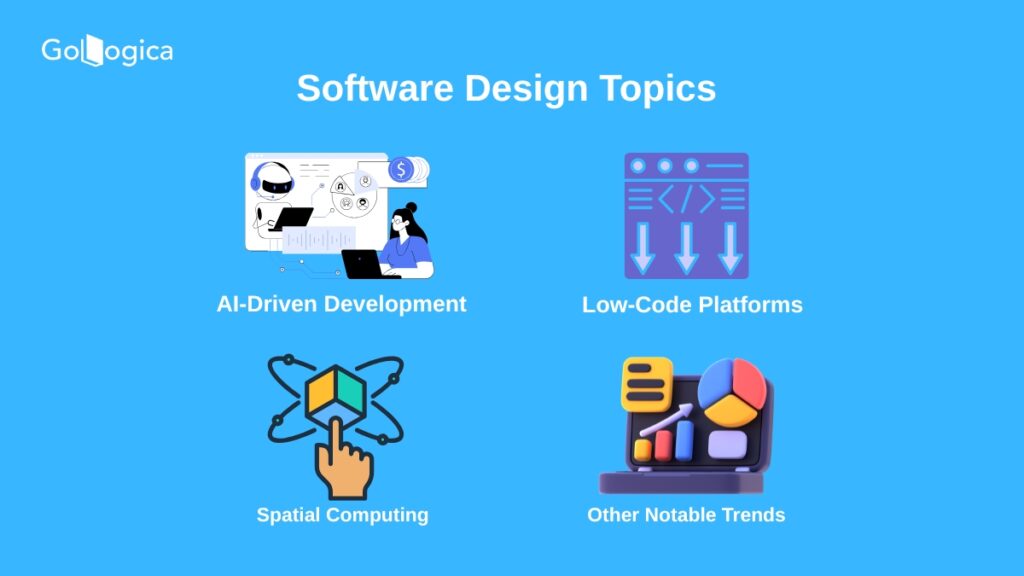
The world of software design will change radically in the next seven years due to the trends in artificial intelligence, automation and clouds. The use of AI has come to the frontline, driving anything and everything to be coded and debugged to intelligent automation of whole software lifecycles. Development processes now include tools such as GitHub Copilot and specialized code agents that make workflows more productive and eliminate human, repetitive work. The move is not only increasing the speed, but it is also changing the future role of developers as drivers who will coordinate the products of AI assistance and work side by side with autonomous systems.
There is also low-code and no-code platforms, whereby software creation is even more democratized, which enables business users and citizen developers to develop applications, possessing the visual interface and limited amount of code. This flexibility speeds up the digital transformation and rapid prototyping as developers concentrate on the integration and extension of these platforms to complex and enterprise-level requirements. Concurrently, cloud-native technologies and microservices are gaining ground, as companies are adopting less rigid solutions to an ever more digitized economy.
The need to employ security and ethical uses of AI has been necessitated as important design factors, and notions such as AI Trust, Risk, and Security Management (AI TRiSM) have emerged to afford solutions to emerging issues with automation and data management. Edge computing, cross-platform frameworks, and neuro-inclusive user experience design are also on the rise, and they thus guarantee that software is extremely responsive and inclusive.
In a nutshell, five features characterize software design in the year 2025, and they include smarter automation, humanity-focus, AI everywhere, and the urge to create ethically, securely, and scalable solutions that will enable the developer and consumer alike to build the future.
AI-Driven Development
The new era of productivity and accessibility is coming in 2025 because of AI-enabled development, which is transforming how software is constructed, administered, and extended. Artificial intelligence driven technology and tools find their way in all aspects of the software development life cycle they can now automatically generate code, debug programs, conduct testing and even literate documentation. GitHub Copilot proposes in real time code, and automatic corrections, whereas AI-driven testing suites provide rapid quality assurance, testing cases and bug detection in a more predictable manner. Even the process of project management is being streamlined based on the use of AI analytics, which would allow a flexible assignment of resources and predict risks.
In addition to discrete tools, the world is experiencing the emergence of the AI as platform, a bottom layer out of which end-to-end development environments are being built. Giant cloud-native corporations like Google or Microsoft have made strong AI hardware and software integrated into their own building environments, and so linguistic-to-code translation or auto-optimizing code can be performed as a unit and organized well within one synchronized interface. This combination removes the clear distinction between textual programming and orchestration but, more essential, qualifies the workflow of a developer, as well as enhancing coordination between organizations.
Low Coding
At the same time, AI-assisted low-code is already democratizing application development. These platforms facilitate the technical barriers dramatically by empowering professional developers and business users so that it is possible to deploy and create prototypes rapidly without deep knowledge of coding. The resultant effect is a change in the industry to make the development cycle faster and more inclusive and innovation focused. When all of these trends combine, software engineering in 2025 will be marked by not only intelligent automation, but also by an increase in accessibility and by perpetual acceleration the foundation of the relationship between humans, AI, and code will be wholly transformed as a result of these trends.
AI-powered tools
Software development is seeing a massive change in 2025 due to the introduction of AI-powered tools that will provide much more efficient and smarter working processes in a shorter amount of time. Popular tools such as GitHub Copilot, Tabnine, and ClickUp use modern machine learning to automate repetitive coding and offer contextual advice and even recode code with high accuracy.
Windsurf and other tools may offer fast code completions and smart Chat, which elevates the productivity and quality of the code produced, even when working with these tools in daily workplaces. Another example of AI-first is that ClickUp can streamline management of projects due to the ability to quickly develop a technical documentation, summarize team meetings, and auto-update common reports so that teams spend less time on boring tasks and more on innovating.
AI as a platform
AI as a platform is understood to be an extensive technology environment that unites all the required tools, infrastructure, and services needed to develop, release, and operate artificial intelligence applications. The platforms simplify the production process as they integrate the crucial elements of development such as preprocessing, machine learning frameworks, and deployment tools into the same ecosystem.
An AI platform gives teams the ability to develop advanced models powered by automation capabilities, machine learning operations (MLOps), and predictive analytics, of natural language processing, computer vision, and business forecasting use cases. The major cloud providers currently provide a ready-made AI platform, which enables organizations to embrace and scale AI applications quickly without necessarily forming the behind-the-scenes infrastructure ground-up. This unified system makes complicated workflows simple, facilitates cooperation between data science and software developer, and features scalability between the experimental prototypes and production systems in the enterprise. The AI platforms are making the difference in innovation, faster time to market and making businesses use the insights embedded in data to achieve competitive advantage.
AI-augmented low-code
One of the most recent ways through which software development is evolving in 2025 is with the help of AI-augmented low-code tools that combine the strengths of artificial intelligence with the power of visual and simple-to-use platforms. These platforms allow not only technical users but developers to create, customize, and launch smart applications faster than before and with a lower need to code. With the help of incorporated AI coding and automation capabilities, various processes (including code generation, workflow optimization, and data integration) have become more convenient and effective than ever before.
Using low-code enabled with AI allows organizations to achieve a much-accelerated development cycle, cost-efficiency, and scaling without difficulties. The advanced technology can now be utilized by more businesses rather than very specialized individuals with significant amounts of knowledge in machine learning and data science since company owners and managers can easily build prototypes and release AI-powered solutions. The top platforms, such as Salesforce Lightening, OutSystems, Mendix, and Appian demonstrate how the AI-intelligent automation is shutting the development gap between legacy development and business-driven innovation.
This is because, in its purest form, AI-accelerated low-code gives businesses access to advanced AI capabilities and reduces the hurdles to software development. Such a combination of factors is likely to drive digitalization on the industry level and reform the shape of the app development future.
Low-code and no-code platforms
In 2025, the software development landscape is being transformed as low-code and no-code platforms give all users, technical or non-technical alike, the tools to create applications quickly, without sophisticated code knowledge. These platforms allow significant time and cost savings in the development process, as long as they offer drag-and-drop connections, pre-designed templates, and visual logic components, and open the realm of digital transformation to any organization of any size.
The rise of the adoption, whereby approximately 66% of developers are using and intend to use them, is responding to the world scarcity of quality developers and assists corporations to counter the pulse in commercial conditions more urgently. Their enterprise readiness has been further enhanced by integration with AI, real time collaboration and integration with legacy systems and the cloud in seamless modes.
With low-code/no-code solutions, time-to-market is now faster, IT projects backlogs are smaller, and non-programmers known as citizen developers can innovate with the creation of applications to meet the needs of a specific business. New application areas include healthcare and retail among others and it has been evidenced that these platforms will be central to effective operations and growth in the digital-first environment.
Democratization of development
Software industry in 2025 is radically changing with democratization of development. Driven by the emergence of low-code and no-code (LCNC) platforms, the trend gives people with no serious technical education the chance to learn to design, prototype, and deploy applications faster than ever before.
Companies are now able to develop useful applications and even deploy MVPs without completely having to rely on development teams and make the digital transformation and solutions to problems more department-based. The intuitive, visual tools presented by these platforms reduce the burden of entry and give business users and citizen developers the chance to make contributions to the software projects and meet the needs of the organizations faster.
This has become a democratized development and with that, no longer does access only belong to those who have years of experience under their belt as programmers but instead, the talent of creativity and business smarts also prove to be indispensable in creating significant pieces of software. Consequently, firms are realizing quicker time-to-market and adaptation to the changing needs and requirements. In 2025, the trend to democratization does not only accelerate digital transformation but also provides empowerment culture, as the development of software programs is a team effort and organization-wide initiative.
Industry-specific solutions
In 2025, industry-specific solutions are revolutionizing how organizations function by addressing the unique needs and challenges of each sector. Unlike general-purpose software, these tailored systems focus on critical industry workflows, regulations, and operational requirements—for example, healthcare uses specialized solutions for electronic health records and billing automation, while manufacturing benefits from predictive maintenance and smart factory integration, Retailers leverage AI-driven demand forecasting and seamless point-of-sale systems, while logistics companies rely on route optimization and warehouse automation.
These vertical market solutions deliver higher productivity by eliminating unnecessary features and ensuring compliance, resulting in fewer workflow disruptions and faster adoption, The dominance of cloud-based and hybrid ERP models further brings scalability, real-time data processing, and cost savings to businesses. By providing pre-built workflows and seamless integration—whether in healthcare, retail, or manufacturing—industry-specific software empowers businesses to operate efficiently, adapt quickly to regulatory changes, and maintain a competitive advantage in their markets.
Integration with AI
Innovation of content creation is changing with Artificial Intelligence (AI). Content creation is being made smarter, quicker and more affordable to both individuals and businesses. In 2025, there is a broad set of AI-based tools that can be used to create the high quality articles, social media content, marketing materials, and blog posts with unprecedented effectiveness. Jasper AI, ChatGPT and Write sonic are some of the most versatile tools that can create everything, starting with long-form articles based around SEO concepts, down to catchy captions on a social media post, without ever losing the brand voice and style. A big number of them have templates available to various types of content and they are easily tailored resulting into making the user who is even not tech savvy have a publication ready content in minutes.
The toolkit created by Google itself but consisting of a set of AI tools that enable the creator to not only prepare the content draft but also analyze and optimize it due to the powerful sentiment analysis and content classification capabilities that Google AI Studio and Natural Language API have to offer. Such developments have necessitated the use of AI to be at the forefront of content strategy in the contemporary world and it has been reported that more than 90% of businesses currently use the generative AI to promote their content marketing procedures.
AI content
With AI content generators, users can be able to meet their tight deadlines of content creation, enhance creativity to create a more interesting content and build organic traffic through intelligent and data driven writing. Nonetheless, although AI is able to automate most of the process of this drafting, the human editing of a skillful individual is relevant so that to add the element of nuance, precision, and originality to every work. This has made AI-based content production transform the online space that fuels productivity and impact in various sectors.
Spatial Computing
Spatial computing will revolutionize the way we can use technology to simply blur the lines between the physical and the digital and succeed in that. To be more specific, immersive experiences in 2025 are leading the pack of this evolution enabling individuals to enter into digital worlds through augmented reality (AR), virtual reality (VR), and mixed reality (MR) gadgets. Such systems are much more than watching, so multi-sensory interactions make it highly engaging, people can touch with their hands, make gestures, and communicate in natural ways, establishing a stronger mental bond in training, entertainment, or collaborative situations.
Software fulfillment is one of the hallmark characteristics of spatial computing. Unlike limiting the computing process to the screen, spatial software redefines computing capabilities with the use of sensors, cameras, LiDAR, GPS, and AI-driven analytics, maps, and comprehends real-world spaces. This can allow cases of real-time assistance on manufacturing floor, displaying medical information on the top of surgeries, 3D modelifying classrooms. Digital twins are the accurate virtual copy of a physical object or place, which industries can use to simulate processes happening in the real world, to observe, and even optimise it without interruption.
Inputs
All this precipitated by a tidal surge of new hardware and software. The newest AR glasses, light-weight MR headsets, and sophisticated sensors are ergonomic, have ultra-high-resolution displays, and can be worn all day long to increase productivity. Smart wearables, such as Apple Vision Pro or Microsoft HoloLens 3, are no longer alone, but fully become the trend as more and more devices and technologies focused on spatial computing focus on business and consumer markets. With the benefits of AI and better connectivity these new systems provide a much richer immersive content, easy to use gesture controls, as well as the ability to carry with them contextual digital overlays, ushering a new age in which the differences between the virtual and the real continue to blur.
Other Notable Trends
The digital environment is being transformed as new technologies are coming along. DevSecOps employs security in the patterns of development pipeline so that software gets developed vigorously and successfully. Cloud native architectures and microservices allow scalability, and flexibility to enable speedy roller-outs and innovating, backed by better architectures.
Finally, Blockchain technology that previously existed in financial applications has evolved to simplify supply chains, healthcare and digital identity management.
In the interim, edge computing brings processing to a data creation point and thus minimizes latency and makes real-time analytics–key requirements in IoT and smart devices–available. With the increased demands on IT infrastructure, energy-efficient computing plays an increasingly important role and organizations want to find the ways of reducing costs and carbon footprints without compromising on performance, in sustainable ways.
Taken together, these tendencies are the messengers of the future of security, flexibility, decentralized intelligence, and eco-friendly activities and bring forth the next generation of technical development.
DevSecOps
One of the modern approaches is called DevSecOps and implies the integration of security procedures into all stages of the software development lifecycle. Compared to their traditional counterparts, where security is considered to be an after-thought and handled by a security team at the end of the development cycle, DevSecOps will imply that security is shared responsibility among developers, security professionals, and operations teams since the start of the development process.
The integration plays a vital role in the modern high-speed development conditions, when the rules are fast releases and steady updates. DevSecOps reduces threats and enables early detection and resolution of security challenges due to automation of the security process, application of vulnerability detection tools and enhanced collaboration.
The basic aim of DevSecOps is to provide software, safer, sooner: fast and agile delivery without trading-off security. The cultural transformation and change in the approach is also necessary in countering the escalating cyber threats so that organizations can develop secure and compliant software that supports both business and security requirements in the highly complex digital world.
Cloud-native and microservices
Modern application development is based on cloud-native technology and microservices that allow organizations to quickly develop and deploy highly products that are highly scalable, resilient, and can adapt to meet new demands in the market. Cloud-native Cloud-native is the use of design, building, and operating workloads that operate fully on cloud environments and enables quick scaling and smooth management of resources.
The defining characteristic of cloud-native development is the microservices architecture, or the technique of dividing multicomponent applications into the set of small and autonomous services. The microservices deal with a specific business operation and communicate with each other through lightweight interfaces, including APIs, enabling simple updates and scaling, without affecting the whole application.
By moving to the microservices in a cloud-native strategy the development teams will win a number of advantages: services may be deployed, updated, or scaled into isolation and fail less frequently, but there is a continuous delivery also. Containers are usually the pay container that makes microservices portable and efficiently used within different environments.
It is a fault-tolerant approach as well, since a bug in one microservices does not disturb or knock out the whole system. Finally, cloud-native microservices can make an organization innovate quicker, address dynamic business requirements, and have a competitive advantage in the modern digital environment.
Blockchain beyond finance
Blockchain, the technology behind cryptocurrencies, has been established as an exciting technology with a long reach even outside the financial industry. The essence of Blockchain is a decentralized and immutable ledger that supports secure, transparent, and immutable recording of data between more than one parties. Other than finance, industries are using Blockchain to innovate and establish trust.
Blockchain has the capability to offer complete end-to-end visibility in supply chain management which in turn helps in the authenticity of the products and minimizes fraud. Healthcare organizations can store and exchange patient data safely, providing more privacy and data integrity. Governments are considering Blockchain-powered voting schemes that will provide both transparent and tamper-proof elections, and academic institutions verify tamper-free certificates and credentials.
Blockchain is applied to decentralize peer-to-peer energy trading within the energy sector, promoting sustainability and more consumer control. The use of smart contracts and record protection in Blockchain are opening up new opportunities and redesigning the ways trust, transparency, and efficiency can be provided to a wide range of sectors in every application.

Edge computing
The trend in modern computing processes is edge computing which takes place and analyses the data near its point of origin instead of using purely centralized cloud servers. Edge computing overcomes the shortcomings of the cloud with many advantages, one of the most remarkable of which is the ability to minimize latency with the help of IoT sensors, smart cameras, or local servers (located on the edges of the network) allowing a rapid response to applications that need real-time decision-making.
Such geographic strategy not only reduces the bandwidth consumption and network traffic, but also provides increased security since sensitive data is stored locally where it is created. Sectors such as autonomous cars, health, production, and smart cities are being served by edge computing so that enormous batches of information may be processed promptly to provide on-time knowledge and decisions.
This makes the application perform better, reliability is greater, and it is much cheaper, in particular when used in an environment having many connected devices or remote environments where immediate connection to the cloud cannot always be given. Edge computing is fast becoming critical to the resilient, efficient, and intelligent operations as the number of digital and connected devices continues to rise.
Energy-efficient computing
Energy-efficient computing Scientists and engineers develop energy-efficient computing hardware and software to use energy efficiently without compromising performance. This methodology ranges all the way through to fast algorithms and code, more powerful processors, optimized systems, and savvy power management systems.
Demand in digital solutions keeps on increasing; therefore, the conventional computing infrastructure is likely to demand extensive energy and contribute more resources to the environment resulting in higher expenses. Such challenges are addressed by energy efficient computing that focuses on doing more computing per unit of energy consumed to eliminate waste across all layers including data centers and cloud infrastructure as well as devices used by end consumers.
Through the use of new technologies, like dynamic voltage and frequency scaling, energy-savvy hardware, or best cooling alternatives, organizations will be in a position to reduce their electricity bill substantially, become more environmentally friendly, and ensure long-term sustainable growth. Energy-efficient computing is worthwhile not only because environmentally-appropriate behavior is required, but it also provides economic advantages, compliance value, and serves the livelihood of the technological sector going into a period of increased energy requirements.
Conclusion
The merger of emerging technologies such as the development driven by AI, low code/no code development environment, and new paradigms of computing spells a new wave of innovation and inclusivity in the development of software solutions. The new wave of creation, deployment, and scaling applications with the help of the AI-powered tools and platforms promotes the blistering speed even allowing those with little to no background in IT to contribute to the development process. Such democratization is a lead into the creation of industry-specific solutions, as AI and automation automate operations and decisions in any sector.
Cloud-native, microservices, DevSecOps, and AI integration helps to transform software lifecycles, guaranteeing the agility, strong security, and scalability. Computing at the edge and computing with energy efficiency helps to worsen latency and enhance sustainability, which is an essential concern in the current digital growth. The use of Blockchain in the financial field has changed, as it has become the basis of secure and transparent data structures applicable in all fields. Other innovations like spatial computing increase this digital versus real-life separation in other ways, promoting immersive experiences and demonstrating potential new business models.
Companies that utilize such trends not only become efficient and sustainable, but also evolve into more creative and patient toward change in the marketplace. The situation is getting increasingly open and vibrant as the platforms of enterprises keep layering AI, low-code/no-code, and cloud-native capabilities. Companies utilizing such tools, including those GoLogica has developed or promoted, will thankfully become the future of digital transformation, with technology becoming an actual driver of innovation and expansion.