Table of Content
Introduction
What is a Diploma Course?
Top Diploma Courses in 2025
What is the Difference between a Diploma and Degree?
Which Fields are Offering Diploma Courses in 2025?
Which Diploma Course is better — Online or Offline?
Career Opportunities after Completing a Diploma Course
Best Diploma Course for Your Career Growth
Diploma Course Duration, Fees & Admission Process
Best Countries for Pursuing Diploma Courses in 2025
Skill Development & Certification with Diploma Programs
Future Scope of Diploma Courses in the Global Job Market
FAQs about Diploma Courses in 2025
Conclusion
Introduction
In these days of competitive, high-speed times, diploma course have become influential vehicles for learning skills and career mobility. As we start the year 2025, industry-specific, flexible, and employment-oriented learning has never been in greater demand. If you are a fresh graduate, or wish to upgrade yourself on the job, or switch careers, diploma courses provide specialized instruction and faster entry into the job market than conventional degrees.
This in-depth guide discusses the most popular diploma courses of 2025 in areas such as technology, healthcare, business, design, and more. With sectors changing at a fast pace owing to AI, automation, and digitalization, short-term and special courses have become essential to keep up with competition. From data science and cybersecurity to digital marketing and graphic designing, we give you the most sought-after courses, the eligibility criteria, career prospects, and the top institutions that teach them.
Make this book your guide to making smart choices, choosing the right diploma course to fulfill your aspirations, and a future-proofed job in 2025 and beyond.
What is a Diploma Course?
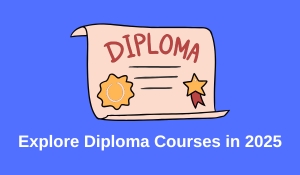
A diploma course is a medium to short-term course of study aimed at passing job-oriented and practical training within a particular field. Compared to academic degree courses that pay greater emphasis to theory, diploma courses pay greater emphasis to practice know-how, industry practices, and industrial application. Diploma courses are offered by technical institutes, polytechnics, colleges, and online web sites.
The programs take anywhere from a few months to two years, depending on the topic and level (i.e., foundation, advanced, or postgraduate). The programs are offered in virtually every field of study—e.g., engineering, information technology, health sciences, business administration, graphic designing, etc.—so that students can acquire specialized skills without making themselves available for a term-long degree.
Best suited for students post-10th or 12th, working professionals, or career change, diploma courses are affordable, quicker to pursue, and employment-oriented. Some of them also have internships or work projects, which enables the students to enter the job market directly.
What is the Difference between a Diploma and Degree?
Diploma and degrees are both higher education although the two differ so much with respect to duration, depth, concentration and career outcome. This is how the comparison becomes clear:
| Aspect | Diploma | Degree |
| Duration | Short-term: 6 months to 2 years | Long-term: 3 to 4 years (undergraduate), 1 to 2 years (post graduate) |
| Focus | Practical Skill-based training | Academic knowledge, research and other more general knowledge |
| Eligibility | After 10th or 12th (depending on level) | Typically after 12th for undergraduate, after graduation for postgraduate |
| Cost | More readily available at a low price | More expensive |
| Depth | It is specialized information about one field | Very thorough knowledge of a topic area |
| Career Path | Fast access to technical or vocational occupations | Greater choice of occupation, frequently essential to professional occupation |
| Institution | Provided by polytechnics, technical institutes and colleges | Provided by universities and universities of higher learning |
Example:
One year Diploma in Graphic Design will also equip you with software and get you ready to take on junior positions such as graphic designer or visual artist though programs such as Photoshop and Illustrator.
A 3-4 year Bachelor Degree in Design will provide an education in design history, theory, user experience, branding, and has studio projects, which lead to a career as a creative director, UX/UI designer, or the continuation of studies.
Concisely, a diploma is shorter, more job-specific and a degree is more broad and detailed in its academic base.
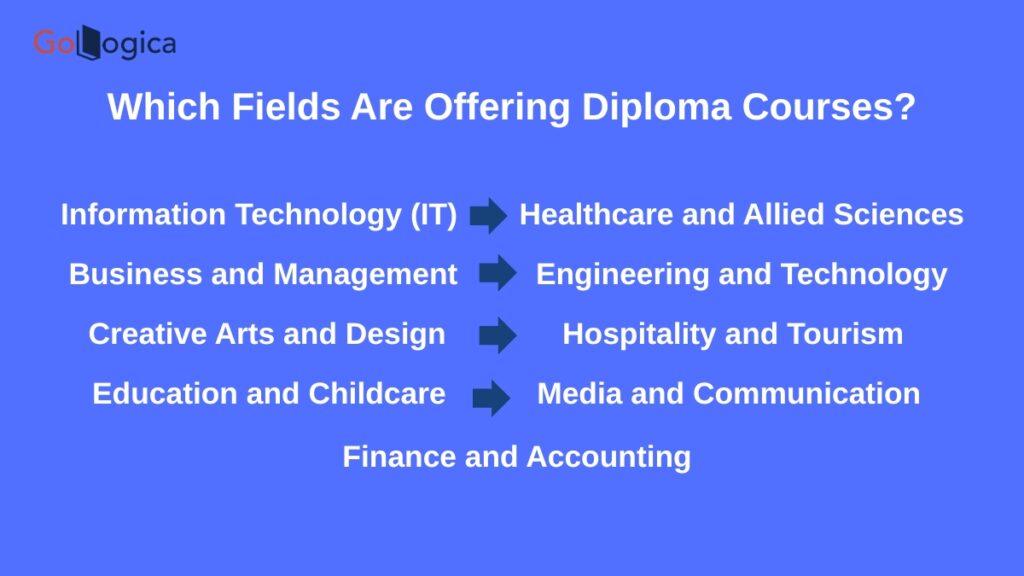
Which Fields are Offering Diploma Courses in 2025?
2025 diploma courses are ideal for students and working professionals who are in search of quick career prospects. All the industrial economy sectors have diploma courses with the same overall aim of addressing the needs of the contemporary world. The following are the highest ranks with diploma courses having respective examples:
Information Technology (IT)
IT is a pre-career option for diploma programs. Web Development, Cybersecurity, Cloud Computing, and Data Analytics diplomas provide job-ready skills in 6 to 12 months. A Diploma in Cybersecurity, for example, provides ethical hacking, threat analysis, and security tools—all transferable in a Security Analyst or Network Security Technician position.
Healthcare and Allied Sciences
Medicine is also changing rapidly, and diploma courses in this sector are required. Some of these include Diploma in Nursing Assistance, Medical Laboratory Technology, Radiology, and Pharmacy Technician. Diploma in Medical Laboratory Technology, for instance, enables one to conduct blood tests, pathology tests, and sample tests in a hospital or diagnostic lab.
Business and Management
Short-term certificates such as Digital Marketing, Human Resources, Finance, and Supply Chain Management are in-demand diplomas. For instance, a Diploma in Digital Marketing educates the student in the skill sets of SEO, email marketing, Google Ads, and analytics and equips the student for digital agency, startup, or in-house marketing job positions.
Engineering and Technology
Engineering diplomas suit grade 10 or grade 12 students. Diploma in Mechanical, Electrical, Civil, or Electronics Engineering trains the student in basic technical career skills. Diploma in Civil Engineering, for instance, instructs the students in construction processes, drawing, and surveying to qualify them as site engineers or CAD technicians.
Creative Arts and Design
For art-interested individuals, diploma-level degrees in Graphic Design, Animation, Fashion Design, and Interior Design are perfect options. Diploma in Graphic Design will provide the students with Photoshop, Illustrator, and In Design software expertise to become a graphic designer, visual artist, or content producer for media companies.
Hospitality and Tourism
This department provides diploma programmes in Hotel Management, Culinary Arts, and Travel & Tourism. Diploma in Hotel Management involves front office subjects, housekeeping, food and beverage, and hospitality laws, which equip students to work for hotels, resorts, cruise lines, and airlines.
Education and Childcare
With growing awareness of quality education, diploma programs such as Early Childhood Education and Montessori Teaching are in demand. Diploma in Early Childhood Education equips teachers to teach preschool or daycare school and specialize in child psychology, play school teaching, and classroom management.
Media and Communication
New media has opened up space in diplomas of Journalism, Public Relations, Content Writing, and Film Production. Diploma in Content Writing is trained for writing SEO content, blogging, technical writing, and storytelling skills which are in huge demand by marketing firms, publishers, and websites.
Finance and Accounting
Diplomas such as Accounting, Taxation, Financial Planning, and Banking prepare a student to become a professional such as Financial Executive or Accounts Assistant. For example, a Diploma in Accounting prepares a student in Tally, GST, and basic financial reporting, and basic finance can place them in a junior finance position.
All such varied sectors that provide diploma courses in 2025 fulfill a vast range of career aspirations and objectives, and it gives the students with a positive and effective means of gaining an employment or professional development.
Which Diploma Course is better — Online or Offline?
An offline diploma course or an online diploma course completely depends on your study routine, career ambitions, personal life, and spending. Both of them consist of advantages and disadvantages, and the “better” one depends on some necessities.
Online diploma courses are the best example of flexibility and convenience. Most appropriate for working professionals, parents, and those who are located in far-off places, online courses allow the student to learn at their own pace anywhere and anytime. They offer video lectures, downloadable study material, and online quizzes in general. For example, one can earn a Diploma in Digital Marketing or Data Analytics with live case studies and actual projects online. But distance learning does require extremely high levels of self-motivation and self-discipline since there is extremely little face-to-face contact and on-the-fly mentoring.
Offline diploma courses, on the other hand, are made available in a more formalized and experiential learning setting. The students are fortunate to benefit from one-to-one face-to-face teaching, inter-personal interaction, hands-on practice, and the campus facilities. Diploma programs like Diploma in Nursing, Culinary Arts, or Engineering Technology are well adapted to be delivered offline because of their practicum nature and the requirement for hands-on training and equipment.
In short, if you are someone who is an independent worker and in need of flexibility, online diplomas are a godsend. But if professional needs call for live practice and interaction with people, an offline diploma will be ideal for you.
Career Options after Obtaining a Diploma Course
Diploma courses are designed to give one specialized skills and knowledge meant for the industry in a bid to place the student in employment within a shorter duration compared to a regular degree. As soon as one gets through a diploma course, there are adequate career opportunities in any field depending on what field was studied.
Computer Science and Information Technology diploma graduates can be employed as Data Entry Operators, Junior Software Developers, Technical Support Experts, or Web Developers. Cyber Security diploma holders can be employed at entry-level in any corporation to serve as a Security Analyst or Network Technician.
In the Healthcare and Allied Sciences cluster, typical jobs include like Pharmacy Assistant, Medical Laboratory Technician, Radiology Technician, or Nursing Assistant. These are all like jobs which are in great demand in clinics, diagnostic labs, and hospitals.
A Diploma in Business or Management may be promoted to a professional level like Marketing Executive, HR Assistant, Sales Coordinator, or Administrative Officer. A postgraduate in Diploma in Digital Marketing can start a career as a Social Media Manager or SEO Executive in a digital agency.
Diploma graduates tend to be employed as Site Supervisors, CAD Technicians, Junior Engineers, or Maintenance Technicians in power, manufacturing, and construction fields.
Over View Of Diploma Course
Diploma courses also have thrilling career options. This is in Graphic Design can be a Visual Designer, an Illustrator, or Content Creator and Diploma in Fashion Design can be a Fashion Stylist or Assistant Designer.
For students choosing their career in Hospitality and Tourism, the diploma program graduates may be a Hotel Front Office Executive, Food & Beverage Executive, Travel Coordinator, or Event Coordinator for a hotel, airline, cruise liner, or resort.
Childcare and Education diplomas qualify one to work as a Preschool Teacher, Daycare Coordinator, or Special Needs Assistant and are the foundations of early education.
For Media and Communications, the diploma holders are eligible for the posts of Content Writer, PR Assistant, Video Editor, or Junior Journalist.
The law stipulates that diploma training ensures the commencement of first-time employment and makes a perfect foundation for first-level professional specialization or occupational change to a chosen profession.
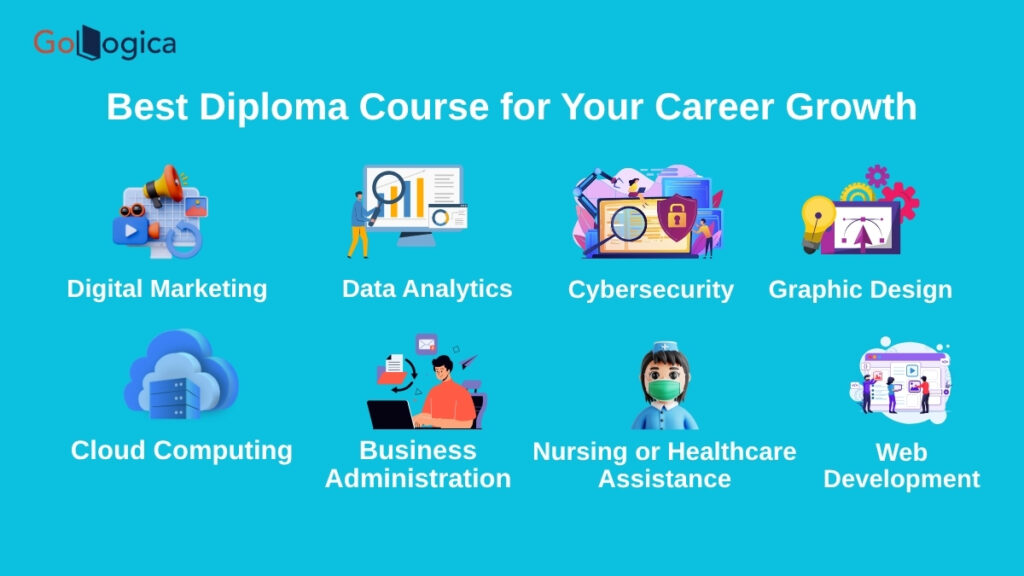
Best Diploma Course for Your Career Growth
Top best suitable diploma course for your career development is based on your interest, industry trend, and end career goals. However, some diploma courses have always been suitable for a career. Some of them have always been with enormous demand and career opportunities. Below are some of the top 2025 best suitable diploma courses which can actually boost your career:
Diploma in Digital Marketing
As companies are going online, the course is apt for students who are looking to make a career in the marketing, content, or e-commerce industry. It includes SEO, SEM, social media, and analytics. The job opportunities are Digital Marketing Executive, Social Media Manager, and Content Strategist.
Diploma in Data Analytics
It is the most popular profession in industries. Excel, SQL, Python, Power BI, and data visualization are included in the course. The graduates can be Data Analysts, Business Intelligence Experts, or Reporting Analysts.
Diploma in Cybersecurity
Cyberattacks have been increasing all over the world, and so the course is worth investing in. The course covers risk management, network security, and ethical hacking. The career opportunities are Security Analyst, IT Auditor, or Cybersecurity Technician.
Diploma in Cloud Computing
The diploma course prepares students for IT professional jobs in cloud computing platforms like AWS, Azure, or Google Cloud. Career options are Cloud Engineer, DevOps Associate, and System Administrator.
Diploma in Graphic Design
A great career choice for creative experts, this diploma includes Adobe software, UI/UX basics, and branding guidelines. Career opportunities are Graphic Designer, Visual Content Creator, or UI Designer.
Diploma in Business Administration
This. A very flexible course with studies on. Business communication, operations, and management. Wannabe managers or wannabe entrepreneurs will love it. Career opportunities are Admin Executive, Operations Assistant, and Customer Service Coordinator.
Diploma in Nursing or Healthcare Assistance
For those interested in having a healthcare career,.these diplomas ensure safe, secure. Stable jobs in hospitals, clinics, and.elderly homes. They can be employed as.Nursing Assistants, Lab Technicians, or.Radiology Technologists.
Diploma in Web Development
This diploma is designed to develop websites using HTML, CSS, JavaScript, and backend programming. It leads to Front-End Developer, Web Designer, or Full-Stack Developer roles.
All these diploma courses are designed to catch up with fast-growing industries and can make you job-ready in a short time or acquire skills for greater opportunity. Choosing which one will depend on where passion meets marketplace demand.
Diploma Course Duration, Fees & Admission Process
Top destinations to pursue diploma courses in 2025 include Canada, Australia, the U.S., Germany, and the U.K. The nations provide diplomas with global recognition, high industry relevance, and hands-on training. America and Australia are said to provide career-oriented courses in IT, business, and healthcare. America offers postgraduate degrees in business, design, and technology. Germany is ideal for technical degrees, engineering, and low-cost vocational education. The U.K. provides trending business, finance, and artistic diplomas. These countries also have post-study work and hence they are favored by those seeking global career prospects.
Skill Development & Certification with Diploma Programs
Diploma courses are most appropriate for learning employability and gaining practical knowledge in a chosen area of specialization. The courses are professionally oriented as opposed to technical courses with an emphasis on technicality, practice training, and application worldwide. Diploma courses enable students to gain specialist skills in IT, business management, health care, engineering, creative arts, and finance.
Diploma courses have one of the advantages that they offer industry-approved certification. That certification establishes your level of knowledge and helps your professional reputation, and that increases the degree of competition in the job market. For example, a Cloud Computing or Cybersecurity diploma will probably include those certifications that are in mind-boggling demand from employers worldwide.
With the addition of special skill and certified qualifications, diploma courses offer students and working professionals a chance to transform professional life, professional employability, and make them compete with the new job market demands.
Future Scope of Diploma Courses in the Global Job Market
The future of diploma courses in the global employment arena is rosier than ever with growing demand for skills-based education and skills-at-the-workplace expertise. As organisations reorganise themselves at an overwhelming pace through digitisation, automation, and globalisation, organisations of any nature are gravitating toward skills rather than conventional degrees. Diploma courses, being professional courses with on-job training for a desired profession, are extremely popular these days as effective entry points into jobs.
Diploma holders are being offered appropriate jobs in areas of Information Technology, Cybersecurity, Healthcare, Cloud Computing, Digital Marketing, and Engineering. Canada, Australia, Germany, and New Zealand are accepting world-class talent with open entry policies, thereby making diploma holders world mobile.
With remote work, global freelancing, and business qualification becoming more prevalent, diploma students can make their imprint across the globe. And with instant reskilling in a short time and continuous learning, diplomas are extremely future-proof for career agility.
FAQs About Diploma Courses in 2025
1. What is a diploma course?
A diploma program is a short-term or medium-length industry course for skills. A diploma course is more work-oriented and shorter than a degree.
2. Who is eligible to join the diploma course in 2025?
Any student who passed 10th or 12th standard can be eligible, based on the course. Graduation or work experience might be required for senior diplomas.
3. How long are diploma courses?
Diploma programs can last anywhere from six months to two years, depending on the level and subject of concentration.
4. Is diploma course worth studying in the labor market?
Yes, employers demand diploma graduates because of employment readiness and career readiness of their graduates, particularly in IT, health, engineering, and business fields.
5. Is diploma course offered online?
Yes. Certain schools provide online diploma courses with a flexible timing, best for working professionals and students studying from home.
6. Approximately how much does it cost for a diploma course?
The charges will be different depending on the course of study and place. It ranges from ₹20,000 to ₹2,00,000 in India. Overseas, it ranges from $2,000 to $15,000.
7. Do organizations hire foreign diploma holders?
Yes, indeed Australia, Canada, and Germany, and numerous other countries, do welcome diploma holders with abilities, mostly in short-occupation areas.
8. Can one change career through a diploma course?
Yes. Or else, diplomas are generally used in a re-skilling or switching to working professions such as online marketing, data analysis, or designing.
9. Is a diploma the same as a degree?
No, it is competency-based and shorter, whereas a degree entails broader academic coverage. In any case, both are valuable in relation to other career objectives.
10. Can one go further for further studies after undertaking a diploma?
Yes, the progression to higher diplomas, certification, or degree courses is made simpler through credit transfer by most of the diploma courses.

Conclusion
2025 diploma courses are a practical, responsive, and professionally oriented option for those students who want to gain practical hands-on knowledge and enter the industry at an early stage. Considering the future industry needs in the context of industries such as IT, medicine, business, graphic designing, etc., the diploma courses have become a popular option among the students and even industry practitioners today. Diploma courses are cheaper, cost-effective, and are designed to fulfill real-world industry demands.
We at GoLogica want you to know about detailed, industry-specific diploma and certification courses. Maybe it’s a new career start, switching to a new career, or just upgrading your skills—trainer-based training with us will guide you to success. Invest in the future—opt for the best diploma course with GoLogica and pave the way for a brighter empowered tomorrow.