Table of Content
Introduction
Reasons Behind the Growth of Generative AI Careers in 2027
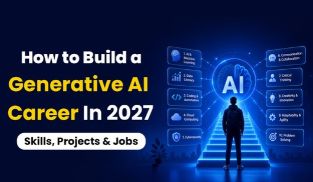
Top Skills for a Generative AI Career
Projects to Build a Generative AI Portfolio
Generative AI Jobs in 2027
How GoLogica Training Can Support Career Preparation
Interview Question & Answers
Frequently Asked Questions (FAQs)
Conclusion
Introduction
The field of Generative AI will offer opportunities for expansion in software development, data science, cloud computing, automation, cybersecurity, marketing, finance, healthcare, and other domains in 2027. Skills in building, integrating, evaluating, and managing AI-powered solutions are needed, as well as using AI tools.
By 2027, with the right skills, some hands-on projects, and knowledge of what is required for a job, a roadmap to job opportunities may be available. Learners can also design their training on specific areas of industry applications and actual technologies using GoLogica Generative AI Training.
Reasons Behind the Growth of Generative AI Careers in 2027.
Generative AI refers to AI models that produce material like text, visuals, code, sounds, films, and formatted data. There are various technologies being developed, including Large Language Models, multimodal AI programs, Retrieval-Augmented Generation systems, AI agents, and enterprise AI technologies.
Generative AI is being incorporated into customer service, software development, document processing and business intelligence, content generation, knowledge management, and workflow automation, among other areas. With growing adoption, the demand for AI professionals who can integrate AI models with live business processes is increasing. With increased adoption, there is a need for professionals who can bridge the gap between AI models and actual business processes.
This provides a chance for people with diverse backgrounds. AI skills can be developed by anyone, from software developers and data analysts to cloud professionals, testers, database professionals, and technology graduates, with a path toward Generative AI careers.
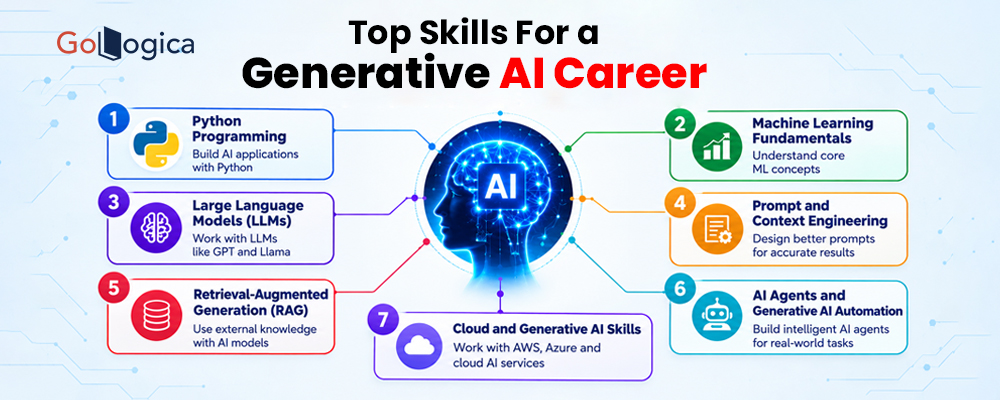
Top Skills for a Generative AI Career
To advance your career, you must have a strong grasp of programming languages, good knowledge of AI theories, hands-on development experience, and a business mindset.
1. Python Programming
Python is still one of the most significant programming languages used in the development of AI and machine learning. Immerse ourselves in variables, functions, OOP, APIs, file handling, data structures, exception handling, and package management.
It’s also essential for AI practitioners to familiarise themselves with some of the popular Python libraries and frameworks that are applicable to data and machine learning pipelines.
2. Machine Learning Fundamentals
There is a strong need to understand the basics of machine learning for Generative AI. It is important to have an understanding of concepts like supervised and unsupervised learning, training data, validation, model evaluation, overfitting, embeddings, and model inference.
As generative AI is based on advanced machine learning, mastering the basics will improve the way you work with modern AI.
3. Large Language Models
Large Language Models (LLMs) play a key role in numerous Generative AI applications. Knowledge of language model information processing, response generation, tokens, and context.
Important concepts include:
- LLM architecture explains how large language models are structured.
- Tokenization breaks text into smaller units called tokens.
- Context windows determine how much information a model can process at once.
- Embeddings represent text as numerical vectors.
- Inference is the process of generating outputs from a trained model.
- Fine-tuning adapts a pretrained model to specific tasks.
- Model evaluation measures the accuracy and quality of AI outputs.
- Prompt engineering helps guide models toward relevant responses.
- Structured outputs organize AI responses into formats such as JSON.
It is not essential to create a new language model from scratch. We need only to use the existing models to create efficient applications of AI.
The Importance of Prompt and Context Engineering
The profession that works with Generative AI requires prompt engineering skills. A well-made prompt offers clear instructions, relevant context, limitations, examples of prompt use, and formats of the expected output.
Using AI technology in practical commercial activities requires more than just typing in a command; it includes knowing how to implement a command system, which guarantees the input of data into the system at the right time.
One needs to be aware that creating a working program based on AI is a laborious task. Designing a good flow of information means implementing effective communication between people, programs, databases, tools, and AI systems.
Retrieval-Augmented Generation (RAG)
RAG is one of the most valuable concepts to use for enterprise Generative AI applications. A RAG application does not necessarily have to store information in a model only, but instead can also find relevant information in external knowledge sources and make it available to the model.
RAG Workflow typically includes:
- Gathering papers or business data.
- Cleaning and preparing the data.
- Dividing documents into suitable parts.
- Creating embeddings.
- Storing vectors in an appropriate database.
- The ability to access pertinent information based on a user’s query.
- Providing context to an AI model.
- Creating a reply based on what they are provided.
- Assessing the product quality and correctness
By learning this workflow, we have valuable hands-on experience with building enterprise AI applications.
AI Agents and Generative AI Automation
Another important task for 2027 is agents based on Artificial Intelligence (AI) technology. Agents can perform more complex activities that require them to work with application programming interfaces (APIs), databases, and workflows in agent-based systems.
Due to the agents’ ability to utilise different models and systems, they are able to achieve better results in what they do. For instance, a virtual assistant can follow instructions, search for information in a database, search through external APIs, carry out a relevant analysis, and provide the answer to the user.
We should therefore learn concepts such as:
- Tool calling
- Function calling
- Agent workflows
- API integration
- Memory and context management
- Task planning
- Workflow orchestration
- Agent evaluation
These skills can be particularly valuable for developers building business automation solutions.
Cloud and Generative AI Skills
In general, nowadays, AI technologies are integrated through the cloud. That is why it is important to be well-versed in such terms as cloud technology, APIs, authentication, deployment, storage, networking, monitoring, and security.
Knowledge of platforms like AWS, Microsoft Azure, and Google Cloud may help entrepreneurs gain Generative AI knowledge. Furthermore, it is important for experts in the field to know how AI technologies work with the existing infrastructure of clouds.
Projects to Build a Generative AI Portfolio
A portfolio of practical work proves skills better than mere theory does. One should implement projects that solve real-life examples and keep records of the technologies and architectures used.
Chatbot based on Generative AI
The chatbot can be developed based on an LLM API. The project will demonstrate prompt engineering, API integration, conversation management, error handling, and interface design.
RAG-Based Document Assistant
A RAG document assistant is an excellent portfolio project. We can allow users to upload documents and ask questions about their contents.
The project can demonstrate document processing, embeddings, vector search, retrieval, prompt construction, and response generation.
AI Resume Assistant
There is an AI Resume Application that takes an individual’s resume and analyzes it in comparison to the job description, identifying skills, missing keywords, and potential improvements. This will allow us to illustrate structured prompting and text processing.
AI Coding Assistant
We could create an application that would explain code, generate code snippets, detect any possible problems, or generate documentation. This way, the usefulness of LLM abilities would be shown in practice to developers.
AI Customer Support Assistant
A customer service assistant sourced from the enterprise can use the RAG method and the large language model (LLM) to respond to queries based on an existing knowledge database. In addition, we can introduce escalation workflows, feedback mechanisms, response assessment, and a conversation logging capability.

Generative AI Jobs in 2027
There are various careers within the Generative AI industry. While roles differ from company to company, some of the more popular ones include:
Generative AI Developer
The developers of Generative AI create applications with LLMs and other foundation models. They can be engaged in tasks such as API development, prompt engineering, RAG pipelines, databases, app creation, and AI integration.
AI/ML Engineer
AI/ML engineers build pipelines for machine learning projects, deploy, test, and release infrastructure, and build machine learning systems. The field of Generative AI can be a vital component of this overall function.
LLM Engineer
LLM engineers specialise in applications involving language models. It can cover model integration, fine-tuning, RAG, evaluation, optimising inference, and the architecture of AI applications.
AI Application Developer
The job of an AI application developer requires developers to incorporate AI functionalities into existing commercial software. Good programming, API, cloud, database, and software-development knowledge will greatly help one on the career path.
AI Solutions Architect
An AI solutions architect works at a higher architectural level, determining how AI systems interact with enterprise applications, data, cloud infrastructure, security, and business processes.
How GoLogica Training Can Support Career Preparation
When it comes to going from the fundamentals to actual applications of Generative AI, quantitative learning approaches are required. GoLogica Generative AI training can be considered an initial step in teaching people willing to learn these concepts.
Efficient training needs to be organized before being transformed into independent practices. It is essential to cover the foundational knowledge and apply different projects that would serve as a means of learning through experimentation with the use of APIs, documentation, and solving real-life problems.
Interview Question & Answers
1. How would you design a Generative AI application for an enterprise use case?
I would identify business requirements, select an appropriate LLM, integrate relevant data sources and APIs, implement security controls, evaluate outputs, and deploy the application with continuous monitoring.
2. How do you evaluate the accuracy and reliability of a Generative AI application?
I would test response accuracy, relevance, factual consistency, and groundedness using representative datasets, automated evaluation metrics, human feedback, and continuous monitoring to identify errors and improve performance.
3. What challenges can occur when deploying Generative AI applications in production?
Common challenges include hallucinations, data privacy risks, prompt injection, latency, and high costs. I would address these through security controls, validation, monitoring, testing, and performance optimization.
4. How would you reduce hallucinations in a Generative AI application?
I would use trusted knowledge sources, implement RAG, provide clear prompts, validate generated responses against source documents, and configure the application to acknowledge uncertainty when reliable information is unavailable.
5. How would you choose between fine-tuning an LLM and using RAG?
I would choose RAG for applications requiring frequently updated external information, while fine-tuning suits specialized tasks or response styles. The decision depends on accuracy, cost, data, and maintenance.
Frequently Asked Questions (FAQs)
What abilities do you imagine will be in demand for Generative AI jobs in 2027?
To thrive in the era of Generative AI in 2027, it is essential to learn how to code in the Python programming language, understand basic machine learning concepts, grasp the operation of Large Language Models (LLMs), be trained in prompting, and understand the fundamentals of retrieval-augmented generation (RAG), in addition to knowing how to use cloud computing. Additionally, there will be opportunities.
Are you in a job position where you have to become familiar with Python for Generative AI?
Python is very useful for building Generative AI applications, as it has AI libraries and frameworks, API integration, and application-building capabilities. To dive into the world of LLM applications, RAG systems, and AI automation, it is beneficial to get a strong foundation in the basics of Python programming.
Is it possible for novice users to begin to work with Generative AI?
Yes, anyone who is new to the field can delve into the world of Generative AI by learning to program, grasping fundamental machine learning concepts, and testing out existing AI models and APIs. Practical projects can be developed and recorded in a portfolio, which can be used to showcase their skills to potential employers.
Which projects can you do to develop a Generative AI portfolio?
Portfolio pieces in Generative AI could include an AI chatbot, AI document assistant (RAG), AI resume assistant, AI coding assistant, and AI customer support assistant. These are all great ways to demonstrate the skills that are essential for working with Generative AI, including prompt engineering, API integration, embeddings, retrieval, and application development.
What sets apart RAG from AI agents?
Retrieval-Augmented Generation (RAG) is a process that helps retrieve relevant information from outside sources of knowledge and use it with an AI model to generate knowledgeable answers. On the other hand, AI agents can undertake tasks that involve a combination of various methods, including models, tools, APIs, and workflows. The incorporation of RAG within an AI agent can assist it in gaining essential information.
In what way can GoLogica Generative AI training assist students in their career preparation?
GoLogica Generative AI training serves as a part of their learning process, where students are exposed to Generative AI concepts, tools, and applications. Students, after completing the training, have to work on several real-time projects, use APIs, create their own portfolio projects, and prepare for job interviews.
Conclusion
In 2027, to have a successful career as a Generative AI developer, an individual should not only be able to use AI tools but also create their own. The skill to pursue a career in Generative AI in 2027 is the ability to interact with AI tools as well as produce AI tools. Especially, programming, machine learning fundamentals, LLM knowledge, prompt engineering and RAG, AI agents, cloud technologies, application development, and hands-on project experience are necessary.
For example, the GoLogica Generative AI training may be one of the learning processes. But the best career prep is to take what we’ve learned and apply it to real projects and be able to talk about how those systems work.