Table of Content
Introduction
What Is an AI Strategist?
Why AI Strategists Are in High Demand in 2026
Key Responsibilities of an AI Strategist
Top Skills Required to Become an AI Strategist in 2026
Educational Qualifications & Certifications for AI Strategists
AI Strategist Career Path & Job Opportunities
AI Strategist Role & Salary Trends in 2026
Conclusion
Introduction
AI is no longer a support feature, but an element of business strategy and innovation. A new leadership role is now emerging as organizations are increasingly using AI to enhance decision-making, automate operations, and build competitive edges, the role of AI Strategist. This position is essential in 2026 to ensure that AI efforts are aligned with business objectives, that AI is ethically and responsibly adopted, and that AI investment returns are maximized.
An AI Strategist is a facilitator between the world of technology, business, and leadership. They assess the places and ways AI can add actual value, determine AI roadmaps over the long term, and direct cross-functional teams to successful implementation. In addition to technical knowledge, the position requires a high level of strategic thinking, knowledge of the domain, and knowledge of the changing regulations and trends in the market.
This paper discusses the nature of an AI Strategist, their major functions and duties, and the most important skills to be effective in the fast-paced and technologically changing world of AI in 2026.
What Is an AI Strategist?
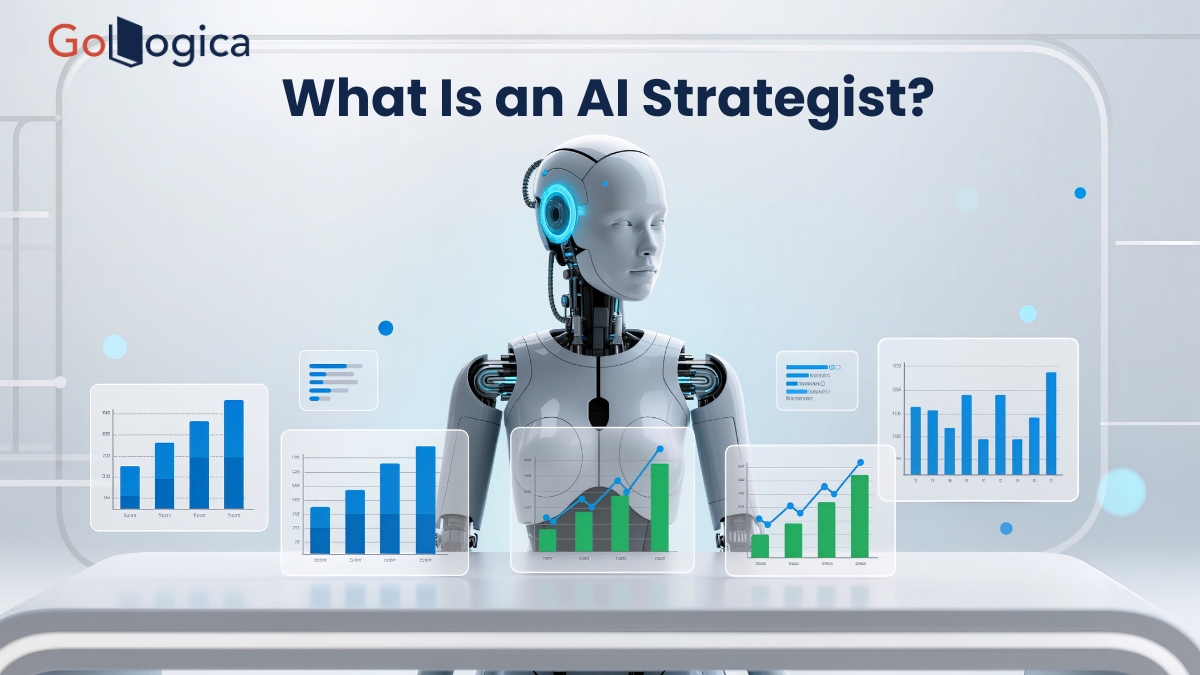
An AI is someone who defines, leads, and implements the vision of Artificial Intelligence of an organization in accordance with its business goals. This is a high-level, business-first thinker who, instead of theorizing on building AI models or writing code, makes sure that AI efforts provide real, measurable value in the business.
It determines where and how AI can be used to address the business issue, increase its efficiency, improve the experiences of customer better, and generate new sources of revenue. They are tasked with being a connector between technical teams (data scientists, AI engineers, and IT) and business stakeholders (leadership, product teams, and operations), as well as to simplify the intricate AI ideas into a strategy.
These aspects of governance and responsibility are in 2026. They assess the moral standards, data security, standards, and risk measures to make sure that AI systems remain open, equitable, and consistent with regulatory norms. Also, keep pace with new AI trends, technologies, and market dynamics, assisting the organizations in keeping pace with the ever-changing digital environment.
Why AI Strategists Are in High Demand in 2026
The demand for AI Strategists in 2026 is high because organizations no longer experiment with Artificial Intelligence but scale it to actual business value. Businesses have learned that the success of AI does not just lie in the high-quality technology, but also in a clear strategy, the correspondence to business objectives, and their measurability. This would mediate between the technical staff and the management by discovering high-impact AI applications and achieving a high payback.
Blistering development of generative AI, automation, and intelligent systems has also multiplied the demand for professionals capable of assessing tools, choosing the appropriate platform, as well as developing AI projects in the future. Meanwhile, an increasing amount of interest in the topic of data privacy, ethical AI, and regulatory adherence needs to be addressed strategically. AI Strategists assist companies in being responsible, transparent, and acting according to international regulations when it comes to AI implementation.
As the rivalry in each industry is fierce, the strategic use of AI puts a distinct competitive edge on businesses. This renders AI Strategists necessary for sustainable growth in 2026.
Key Responsibilities of an AI Strategist
The most important tasks of an AI Strategist are balancing the purpose of AI efforts with business objectives and responsible and scalable use.
It starts with the definition of AI vision and roadmap in the organization. This incorporates the determination of high-impact use cases, project ranking, and the establishment of clear success measures, used to establish business value. They also collaborate with the leadership to make sure AI efforts are aligned with long-term strategic purposes.
The other significant role is the role of a business and technical bridge. AI turns the needs of a business into technical specifications and assists the stakeholders in comprehending the abilities of AI, constraints, and results. This will provide efficient cooperation among decision-makers, engineers, and data scientists.
There is also AI governance and AI risk management under its care. They provide information on ethical considerations, data privacy, security, as well as regulatory requirements, to make AI systems transparent, fair, and trustworthy.
Moreover, they assess the new AI tools and technologies, oversee AI investments, and lead change management and adoption within the organization. Comprehensively, an AI Strategist guarantees the attainable sustainability, measurable, and responsible business impact of AI.
Top Skills Required to Become an AI Strategist in 2026
In order to become an AI Strategist in 2026, the experts must possess the rare combination of technical, business, and strategic competencies. Strategic thinking is necessary to view the big picture, align AI projects and organizational objectives, and find high-impact opportunities. Meanwhile, AI and data literacy enable them to know about machine learning models, data pipelines, and analytics to guide technical teams accordingly.
Business acumen assists in relating AI potential to quantifiable ROI through the knowledge of industry trends, market dynamics, and business processes. Leadership and collaboration skills are also required to guide cross-functional teams, affect stakeholders, and promote the implementation of AI across departments. Along with ethical and regulatory awareness, to ensure the compliance of AI systems with the rules of governing policies and data privacy, problem-solving and innovation allow the design of innovative strategies to address demanding business issues. All these skills combined give the ability to make AI a strategic business edge instead of a technical one.
Educational Qualifications & Certifications for AI Strategists
The key to being an AI Strategist in 2026 is that it requires a good educational base and corresponding certifications to be able to merge the technical knowledge and strategies in the field of business.
Educational Qualifications: The majority have a degree in Computer Science, Data Science, Information Technology, Engineering, or Business Analytics. Good mathematical, statistical, and coding skills are essential to the analysis of AI models and solutions based on data. A master’s degree in AI, Machine Learning, Data Science, or Business Administration (MBA with a specialization in technology or analytics) is also popular among professionals who want to acquire in-depth technical skills in addition to strategic and leadership competencies.
Certifications: Certifications are widely accepted in the industry as they assist in verifying professionalism and keeping up with the current trends in AI. The most popular are Microsoft Certified, AI Engineer Associate, Google Professional Machine learning engineer, IBM AIX Enterprise Workflow, and Certified Artificial Intelligence Practitioner (CAIP). Also, AI strategy, data ethics, and AI governance certifications are worthwhile to those who specialize in responsible AI implementation.
Collectively, the proper education and qualifications allow AI to possess the skills and credibility that will allow it to spearhead AI-related business efforts effectively.

AI Strategist Career Path & Job Opportunities
It presents opportunities in a wide variety of industries because organizations are already using AI to develop, become efficient, and innovative. Professionals are generally hired into this area by having a background in data science, analytics, IT, or business strategy, and develop AI projects, digital transformation, or technology consulting experience. Some of the early positions can be Data Analyst, Business Analyst, AI Consultant, or Machine Learning Engineer, where the individual acquires technical skills and business knowledge.
Having experience, one can become an AI Strategist, AI Program Manager, or AI Solutions Architect, with tasks such as defining AI strategy, setting cross-functional team direction, and holding AI initiatives to measurable business value. The opportunities at the senior level are Chief AI Officer, Head of AI strategy, or Director of AI and innovation, with a specific focus on developing enterprise-wide AI adoption, governance, and innovation strategies.
They are highly sought after, particularly in technology, finance, healthcare, retail, manufacturing, and consulting, and offer a versatile and highly rewarding career with strategic and leadership growth opportunities.
AI Strategist Role & Salary Trends in 2026
The position of AI Strategist is powerful and well-paid in the year 2026 because the significance of AI in business transformation has increased very rapidly. It is his or her responsibility to shape and pursue the vision of an organization in terms of AI, to connect AI efforts with strategic objectives, and to make sure that the organization experiences a tangible difference in functions. They engage in collaboration with the leadership and technical teams to deliver high-value AI applications, govern AI projects, and ensure ethical and regulatory standards.
Compensation is attractive salaries according to the value that they add to the company in a strategic sense. The industry data indicates that the average salary of an AI Strategist position, including in senior positions, is between about 130,000 and 200,000 per year, with particular positions (e.g., at a major tech company) ranging between 180,000 and 267,000 per year plus bonuses and equity options.
The number of jobs related to AI leadership and strategy is still increasing due to the focus on AI implementation by businesses, and such roles will be appealing both career-wise and in regard to salaries in 2026.
Conclusion
An AI Strategist in 2026 is a pillar that is imperative in organizations that want to maximize the power of Artificial Intelligence. Together with technical expertise, strategy, and business skills, propel AI programs that can produce tangible value, are implemented ethically and compliantly, and position the firms to achieve long-term success. Having most of the industries with high growth and with good remuneration chances, this career is gaining growth and impact in defining the future of business.
GoLogica knows the increasing demand for experienced AI specialists. Our all-inclusive AI training courses prepare aspiring professionals with the knowledge, foundational skills, and strategies that can keep them successful in this emerging profession. You may want to redefine your professional future or manage AI-related changes. Still, GoLogica can guide you on the way to becoming a success in the AI strategy field in 2026 and the future.