Online self-learning courses offer autonomy, allowing individuals to learn at their own pace. They provide structured training materials with review exercises to enhance understanding. Utilizing multimedia resources like videos and presentations, learners actively engage with the content. while flexibility enables customization of study schedules. This fosters an environment conducive to effective learning and skill development, accommodating personal commitments.
AI apps are no longer responding to questions, they are now becoming application systems that can perform a series of actions. Python provides a means for application developers to link these features to their software logic, data sources, and external services. GoLogica AI Agent Development with Python Training teaches principles of the development of these applications and how components of them can be used to meet real-world needs.
This course investigates how to translate a user's request into a series of actions that can be carried out. Learners learn how a language model understands instructions, role of prompts in defining task requirements, and the role of application logic in what happens once a language model generates its output. AI Agent Development with Python Online Training also covers the addition of context management and structured responses, allowing developers to structure their information and manage results in Python applications.
Another discipline of research is the relationship between an AI agent and tools that it can operate. Professionals learn about Python functions, API calls, connections to external services, and the process of calling a function. These methods enable an application to get records, perform processing, or request some operation from another system. The training also covers input validation, exception handling, and response handling that helps prevent problems from disrupting workflow when integrating.
If an agent requires information that is outside the scope of their current discussion, then knowledge retrieval is important. This course covers text preparation, the process of making embeddings, vector search and retrieval-augmented generation or RAG. Professionals learn how to find information from a group of documents and use that information as context when working with a language model. The course teaches how to find information from a group of documents and use that information as context when working with a language model. These methods are useful when you are creating an application that is dependent on knowledge from documents or an organisation, or on special information.
The training also covers tasks agents might need to complete that require multiple steps. Learners look at how responsibilities can be shared among agents and how the outputs from each agent can be combined to reach a goal. Learners also check the application for mistakes. Find opportunities to improve by using reviews, troubleshooting, and performance evaluations.
AI Agent Development with Python Certification Training is designed for Python programmers, software engineers, AI developers, automation enthusiasts, and technical specialists who want to learn intelligent software design with AI Agents developed using Python. Experience in Python is helpful.
Bring Python skills to the realm of intelligent application development. Discuss how models, programmable tools, external knowledge, and coordinated workflows can be integrated in agent-based solutions. To know the current syllabus, training options, batch dates, and enrolment information, kindly contact GoLogica.
Salary Trends:
According to Indeed, AI Agent Developers with Python expertise earn approximately 6 to 19 LPA in India, while US professionals can earn around $100,000 to $160,000 annually, depending on experience, Python proficiency, LLM knowledge, and practical AI development skills
Want To Learn More?
AI Agent Development with Python Curriculum
Introduction to Artificial Intelligence and Generative AI
Understanding AI Agents and Agentic AI
Traditional AI vs Generative AI vs Agentic AI
AI Agent Architecture and Components
Types of AI Agents
Autonomous Agents and Their Applications
Python Environment Setup
Python Data Types and Data Structures
Functions, Modules, and Packages
Object-Oriented Programming
Exception and File Handling
Working with APIs and JSON
Asynchronous Programming with Python
Introduction to Large Language Models
LLM Architecture and Transformer Fundamentals
Working with OpenAI, Claude, and Gemini APIs
Prompt Engineering Techniques
System, User, and Few-Shot Prompts
Structured Outputs and JSON Responses
Function Calling and Tool Calling
LLM Parameters and Model Selection
AI Agent Architecture and Execution Loop
Creating Your First AI Agent
Goal-Based and Task-Oriented Agents
Reasoning and Planning Strategies
Tool-Using AI Agents
Connecting Python Functions with LLMs
Building Autonomous Workflows
Introduction to LangChain
LangChain Architecture and Components
Models, Prompts, and Output Parsers
Chains and LCEL
Tools and Tool Calling
Agents and Agent Executors
Conversation Memory
Building AI Applications Using LangChain
Introduction to RAG Architecture
Document Loading and Processing
Text Splitting and Chunking
Embeddings and Vector Search
Vector Databases – FAISS and ChromaDB
Semantic Search and Retrieval
Building RAG-Based AI Chatbots
Advanced RAG and Agentic RAG
Short-Term and Long-Term Memory
Conversation and Session Memory
Context Window Management
Persistent Memory with Databases
Vector-Based Memory
Managing Agent State
Memory Retrieval and Summarization
Introduction to LangGraph
Graph-Based Agent Workflows
Nodes, Edges, and State Management
Conditional Routing
Cyclic Workflows
Checkpointing and Persistence
Human-in-the-Loop Workflows
Building Stateful AI Agents
Introduction to Multi-Agent Architecture
CrewAI Framework Overview
Creating Agents and Defining Roles
Tasks, Crews, and Processes
Agent Collaboration and Delegation
Sequential and Hierarchical Workflows
Building Collaborative Multi-Agent Applications
Introduction to Model Context Protocol
MCP Architecture and Components
MCP Clients and Servers
Building Custom MCP Servers with Python
Connecting AI Agents to MCP Tools
Integrating External APIs and Services
MCP-Based Agent Workflows
Planning and Reasoning Agents
ReAct Framework
Autonomous Research Agents
AI Workflow Automation
Agentic RAG and GraphRAG
Multi-Agent Communication
Human Approval and Intervention
Building Domain-Specific AI Agents
Building APIs with FastAPI
Integrating AI Agents with REST APIs
Creating AI Interfaces with Streamlit
Building Interactive AI Applications
Database Integration
User Authentication and Session Management
Streaming LLM Responses
Testing AI Agent Workflows
LLM Evaluation Techniques
Response Accuracy and Quality Evaluation
Hallucination Detection
AI Guardrails and Content Filtering
Prompt Injection and Security Risks
Error Handling and Retry Mechanisms
AI Agent Observability and Logging
Preparing AI Agents for Production
Deploying Python AI Applications
Docker and Containerization
Cloud Deployment Fundamentals
Environment and API Key Management
Monitoring and Performance Optimization
Logging, Tracing, and Debugging
Scaling AI Agent Applications
The GoLogica certification is widely acknowledged, enhancing the credibility of your resume and opening doors to high-level positions in leading multinational corporations globally.
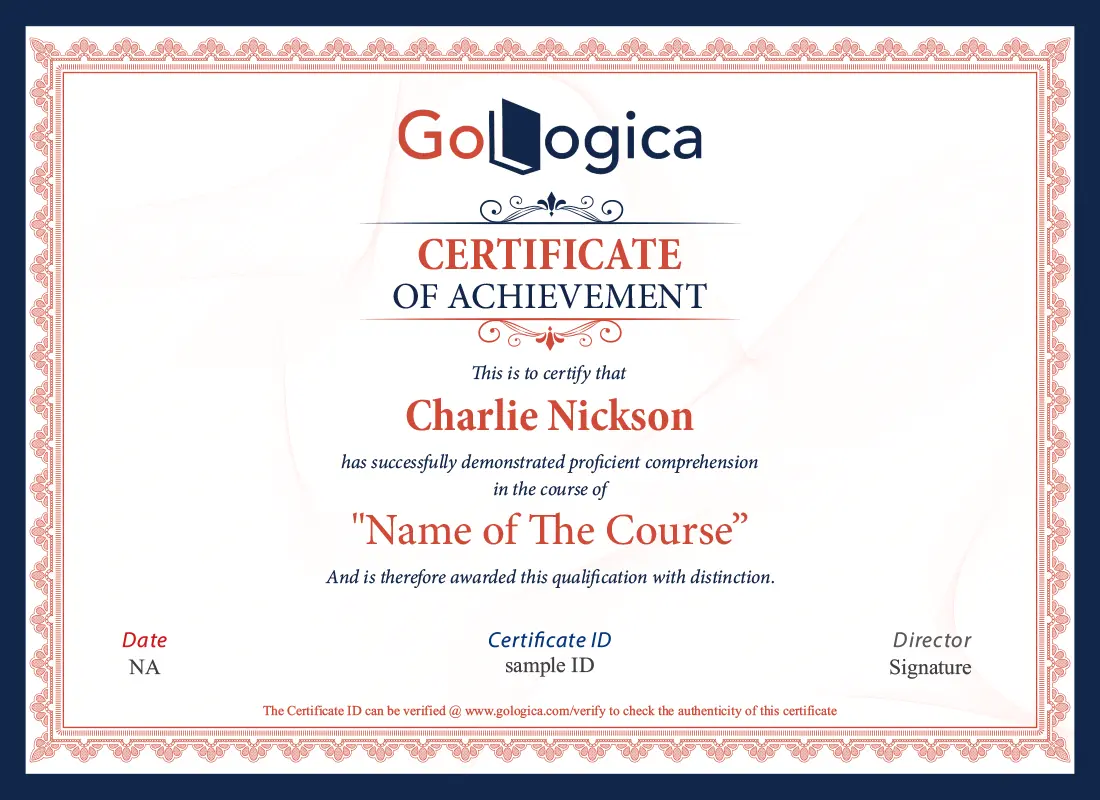
At the end of this course, you will receive a course completion certificate which certifies that you have successfully completed GoLogica training in AI Agent Development with Python technology.
You will get certified in AI Agent Development with Python by clearing the online examination with a minimum score of 70%.
Get Certification
AI Agent Development with Python Objectives
This course teaches you how to use Python to build an AI agent that communicates with a language model, performs actions, pulls in relevant information, and follows instructions.
This course helps Python programmers, software professionals, individuals exploring intelligence, automation specialists, and IT practitioners develop a deeper understanding of how to build applications powered by AI.
Shared components include Python libraries, language model APIs, prompt design, tool execution, memory, retrieval, application interfaces, and workflow management. The various technologies used in exams are dependent on the course syllabus.
Python connects AI models with tools and services, processes user inputs, runs permitted functions, handles results, and guides each step of a workflow to complete tasks efficiently and accurately.
An API or library can be used to communicate instructions and context to a supported language model in Python. This returned output can then be interpreted and utilized in the application's workflow.
Instructions set the agent’s expected actions, limitations, and requests. Prompts provide the information a model needs for a specific interaction and guide the model as to the type of response and/or action that is expected.
Function calling enables a model to call an operation that is available with specified model inputs. The Python app checks to see if the request is valid, runs the allowed function, and returns the return value to be used by the subsequent processing.
An agent can communicate with business APIs, document repositories, databases, search services, and other software, depending on the integrations available. Each link needs to be set up properly as well as have the correct permissions.
Developers can store useful details in chat history, application state, databases, or memory systems for later access, depending on task requirements, privacy concerns, and how long information must remain available.
Explain the importance of embeddings in the context of Artificial Intelligence.
Embeddings are numerical vectors that can be processed by AI systems to represent text (and similar data) and allow for comparison. They can be used for application representation comparison to find semantically related information to a query.
A Python app fetches relevant snippets from the knowledge base and provides them to the language model along with the user's query. This provides the model with extra information as it is formulating its answer.
A vector database stores information as numerical data, helping AI applications find relevant documents or text passages by matching their meaning with a user's query.
With a multi-agent design, each agent gets a different responsibility. They can be coordinated by an orchestration mechanism, communicate with each other, and gather the results from their activities to use for the overall task.
Programmers can look at logs, model responses, function inputs, outcomes, and mistakes. Running tests again with different situations can help find out if problems are caused by prompts, data, connections, or the way the program works.
The knowledge could be useful to AI application developers, Python engineers, automation specialists, software developers, and AI solutions consultants. System development requirements vary based on the employer and the systems' complexity.
Make sure that only approved operations can use the tool to keep passwords safe, and check all inputs. Extra checks and/or a person confirming the action might be required for tasks that deal with information or important company processes.
AI agents can look through company files, make summaries, handle organized requests, answer client questions, and help with business work, based on how accurate things need to be and what systems are connected.
Why GoLogica?
10+
Years of Experience
250+
Corporate Clients
750+
Courses
50K+
Careers Transformed
Yes, it is Possible. GoLogica provides a fast-track Classes so you can complete a training within a few days or a week and get a certification.
To attend online training, you'll typically need a stable internet connection, a compatible device (laptop, tablet, or smartphone), and a suitable web browser or training software.
Check your training platform's storage or cloud (drive) for saved video recordings.
Discounts may vary; inquire directly for specific offers.
Visit GoLogica website, locate the 'Certificates' section, follow the instructions to verify your course completion by completing the exam and Get more than 70% marks. And download your certificate.
I'll guide you through the certification process step-by-step, ensuring you're well-prepared and confident in your subject matter by clearing an exam.
Yes, we help you on a Craft a compelling resume by highlighting your skills, experiences, and achievements in a clear, concise, and well-structured format.
Yes, we do placement assistance after completing a training and clearing eligibility test.
Our mock interviews process involves practice sessions, feedback, and role-playing to enhance candidates' communication skills and confidence in a concise, single-line summary:
"Practice + Feedback = Confident Interview Readiness."
The refund policy terms and conditions may vary; please refer to the specific seller or provider for details. Go to Refund Policy »
Yes, discuss payment terms with the Seles team and Get a potential instalment options.
Yes, you will find EMI options for fee payment.
Get in Touch to our team by filling a required details.
GoLogica certification holds value for those seeking to learn and validate their skills in Logic Apps all over the world.
Yes, GoLogica offers opportunities to work on live projects, enhancing your practical skills and experience.
Our trainers are highly experienced in respective Field and implementing real-time solutions on different Scenarios and Expert in their professionals.
We record each LIVE class session you undergo through this training and recordings of each session class will be updated in your Cloud.
Yes, access online course materials through learning platforms or the institutions or a GoLogica website.
GoLogica have a 10+ year’s good track record in the training market. However, it was founded in 2013.
Yes, we help you on a Craft a compelling resume by highlighting your skills, experiences, and achievements in a clear, concise, and well-structured format.
Self-paced training allows learners to study at their own speed, while Live Online training offers real-time, interactive sessions with an instructor.
Self-paced learning offers flexibility, personalized progress, and the ability to review materials at your own convenience.
Live online training offers real-time interaction, immediate feedback, and networking opportunities, which self-paced learning lacks.
Yes, GoLogica allows you to transition from self-paced to instructor-led training as per your preference T&C apply.
Yes, customize GoLogica curriculum as per your needs. Our Goal is to satisfy and give an enough knowledge to students.
Timetable flexibility depends on the institution and availability; inquire for options.
Yes, depending on program flexibility. Communicate with the organizers for options.
Consult your training contract for withdrawal terms, prioritizing mutual understanding.
Yes, we offer a Demo Session to confirm your enrolment session details for live training.
Yes, the trainer will help you with your queries during the training and as well as in discussion class.
Practice consistently, apply learned skills in real-life scenarios, and seek feedback for improvement.
Yes, we can provide trained resources for hire upon request.
Self-paced videos can be classified into beginner, intermediate, advanced, and expert levels.
Yes, we can consider extending access for pre-recorded sessions.
Yes, customizable live training allows for scheduling flexibility and tailored curriculum.
Yes, we conduct assessments and also some mock test for better understanding along with discussion call.
Yes, we offer a certification and it is highly valuable in market
Yes, you can but just Inquire about extension options post-training.
Yes, post-training consultations can be arranged upon request.
Our trainers are highly experienced in on specific subject matter to teach and uses by real-time solutions on different Scenarios and Expert in their professionals.
You can access the recording of the missed class through our LMS. We record each training session and upload it after the session to our LMS which can be accessible to the students.
You can clarify your queries by dialling +91 - 82 9696 0414, +1 (646) 586 - 2969 Or you can send a mail to info@gologica.com. We are ready to clear your enquiries at any time
AI Agent Development with Python rated
(5.0 / 5) based on 3 reviews.
Karthik S
The course gave me a good introduction to AI agent development using Python. I enjoyed the practical sessions and learned something useful in every class.
Sneha P
The concepts were explained clearly, especially how agents use tools and instructions. The coding examples made the learning process much easier.
Arjun N
Creating a Python-based AI agent was a great experience. The exercises helped me understand how agents can perform tasks beyond simple conversations.