Online self-learning courses offer autonomy, allowing individuals to learn at their own pace. They provide structured training materials with review exercises to enhance understanding. Utilizing multimedia resources like videos and presentations, learners actively engage with the content. while flexibility enables customization of study schedules. This fosters an environment conducive to effective learning and skill development, accommodating personal commitments.
Interested in developing your AI proficiencies? RAG Application Development Online Training introduces you to the concepts of building AI applications with retrieval processes, embeddings, vector databases, LLM integration and real-world RAG workflows. GoLogica lets you learn about retrieval-augmented generation and how it is applied in the real world of AI.
Retrieval-Augmented Generation (RAG) is a useful technique for creating AI applications that work with business-specific, domain-focused, and up-to-date information. A RAG system would not use only the information that is present in the large language model (LLM), but it would also use data from external sources and give the external data as context to the model. This can enhance the quality of the responses the LLM can provide, as it allows the system to access more relevant and informed information. However, the quality of the responses will depend on the information retrieved and the design of the system.
RAG Application Development Certification Training is an introduction to the key elements of these systems and how they are interdependent. Topics covered are document ingestion, Text extraction, chunking, embeddings, vector databases, semantic search, retrieval strategies, prompt construction, and LLM integration.
Learners look at the process of preparing documents for retrieval, the process of determining which content is relevant, and the process of returning the retrieved information to an LLM. This enables them to grasp the potential of AI in converting raw documents and data sources into valuable, context-appropriate responses.
This course is designed for software developers, Python developers, AI and machine learning practitioners, data specialists, technical consultants and anyone interested in developing LLM-based applications. Some basic programming experience is preferred. The technical topics may be easier to understand if you have some prior background knowledge in Python and basic concepts of AI.
The training covers the key steps involved in building a RAG application:
RAG concepts, workflows and application architecture
Document processing, text extraction, chunking and metadata handling
Embeddings and their role in semantic search
Vector databases and similarity-based retrieval
Retrieval strategies and context selection methods
Prompt construction and LLM integration techniques
Evaluating retrieval performance and response quality
You will explore real-world examples of RAG in action and typical pitfalls.
These topics enable learners to grasp the interactions between various parts of RAG in an application. They also delve into typical development hurdles, like poorly-organized documents, subpar chunking, misleading search results, and weak prompts that may influence the quality of responses.
RAG Application Development Training can be combined with Python, Software Development, Machine Learning, Cloud Computing and Data Engineering skills. The models of retrieval, context and language come together to assist learners in developing AI applications confidently.
GoLogica offers hands-on, real-world training to help students grasp the design and development of RAG applications. It introduces the concepts behind retrieval-augmented generation and how to create RAG applications.
Explore RAG Application Development Training with GoLogica and contact us for course details. Enquire Now!
Salary Trends:
According to Glassdoor, professionals skilled in RAG Application Development can earn approximately 8 to 20 LPA in India and $100,000 to $160,000 annually in the US, depending on experience, LLM expertise, Python skills, and practical project exposure.
Want To Learn More?
RAG Application Development Curriculum
Introduction to Generative AI and LLMs
Understanding Retrieval-Augmented Generation
RAG Architecture and Working Principles
RAG vs Fine-Tuning vs Prompt Engineering
Benefits and Use Cases of RAG
RAG Application Development Lifecycle
Python Environment Setup
Python Data Types and Data Structures
Functions, Modules, and Packages
Object-Oriented Programming
File Handling and Exception Handling
Working with APIs and JSON
Python Libraries for AI Development
Introduction to LLM Architecture
Transformer and Attention Fundamentals
Working with OpenAI, Claude, and Gemini
LLM API Integration
Prompt Engineering Techniques
System and User Prompts
Structured Outputs and Function Calling
Managing Tokens and Context Windows
RAG Data Sources and Formats
Loading PDF, Word, CSV, and Text Files
Web Pages and Database Data Extraction
Document Parsing and Preprocessing
Data Cleaning and Transformation
Metadata Extraction
Document Management Pipelines
Understanding Text Chunking
Fixed-Size and Recursive Character Splitting
Semantic Chunking
Chunk Size and Overlap Optimization
Introduction to Embeddings
Generating Text Embeddings
OpenAI and Hugging Face Embedding Models
Embedding Storage and Retrieval
Introduction to Vector Databases
Vector Indexing and Storage
Similarity and Semantic Search
Distance Metrics and Vector Search
Metadata Filtering
FAISS
ChromaDB
Pinecone
Weaviate
Introduction to LangChain Framework
LangChain Components and Architecture
Document Loaders and Text Splitters
Embedding Model Integration
Vector Store Integration
Building Retrieval Chains
Conversational RAG Applications
Source Attribution and Contextual Responses
Introduction to LlamaIndex
LlamaIndex Architecture
Data Connectors and Document Readers
Nodes and Indexing
VectorStoreIndex and Query Engines
Retriever and Response Synthesizer
Query Pipelines
Building Knowledge-Based AI Applications
Naive RAG vs Advanced RAG
Query Rewriting and Query Expansion
Hybrid Search (Dense and Sparse Retrieval)
Re-ranking and Contextual Compression
Multi-Query Retrieval
Parent-Child Document Retrieval
Multi-Hop Retrieval
Self-RAG and Corrective RAG
GraphRAG Fundamentals
Designing End-to-End RAG Architecture
Building Document Question-Answering Applications
Conversational Chatbots with RAG
Integrating External APIs
Database Connectivity
Building RAG APIs Using FastAPI
Developing User Interfaces with Streamlit
Source Citations and Response Generation
Handling Missing or Irrelevant Context
Introduction to RAG Evaluation
Retrieval and Generation Evaluation
Precision@K, Recall@K, and Mean Reciprocal Rank
Context Precision and Context Recall
Faithfulness and Answer Relevance
RAGAS Evaluation Framework
Chunk Size and Retrieval Optimization
Embedding Model Performance
Latency and Cost Optimization
RAG Application Security Fundamentals
Data Privacy and Access Control
Authentication and Authorization
Secure Document Retrieval
Prompt Injection Prevention
Data Leakage Prevention
LLM Guardrails
Hallucination Detection and Mitigation
Preparing RAG Applications for Production
Docker and Containerization
Deploying RAG Applications on Cloud Platforms
FastAPI Application Deployment
Environment and API Key Management
Logging and Error Handling
Monitoring RAG Pipelines
LangSmith and Langfuse
Scaling and Maintaining RAG Applications
The GoLogica certification is widely acknowledged, enhancing the credibility of your resume and opening doors to high-level positions in leading multinational corporations globally.
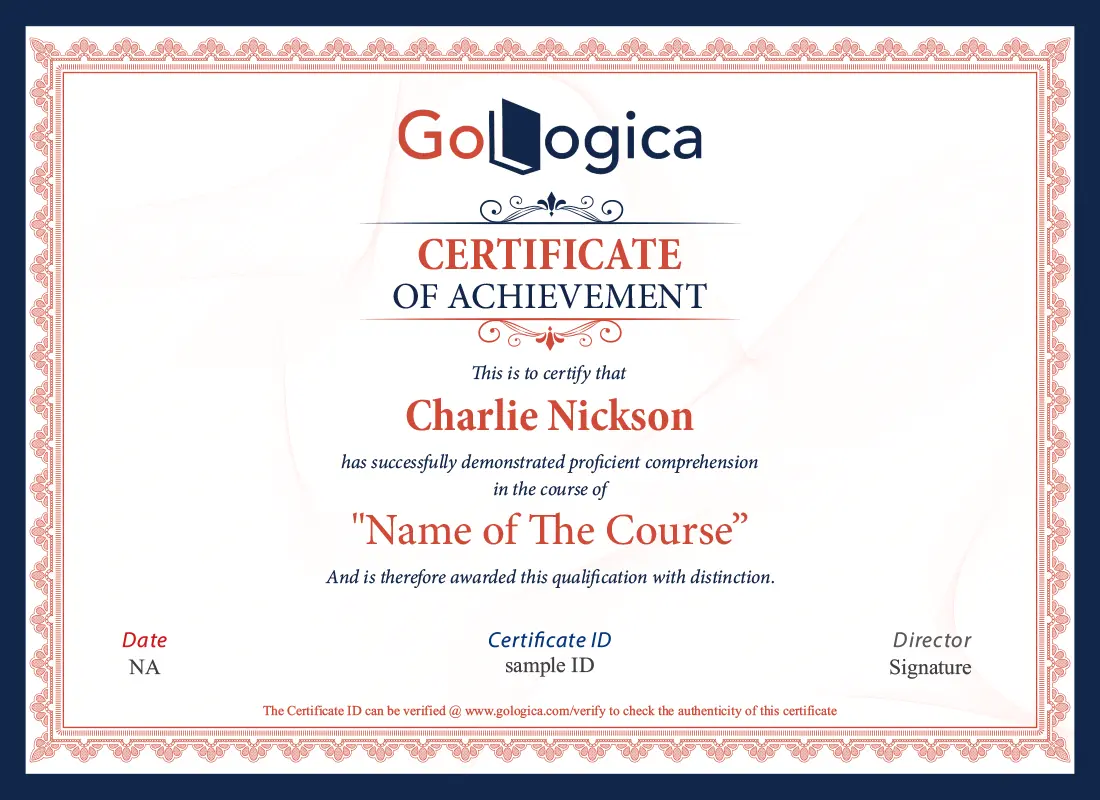
At the end of this course, you will receive a course completion certificate which certifies that you have successfully completed GoLogica training in RAG Application Development technology.
You will get certified in RAG Application Development by clearing the online examination with a minimum score of 70%.
Get Certification
RAG Application Development Objectives
The RAG Application Development Training discusses concepts and techniques to develop applications in the retrieval-augmented generation format. These cover document processing, embeddings, vector databases, retrieval strategies, designing prompts and integrating LLM.
Retrieval-Augmented Generation retrieves relevant information from external sources and provides it to a large language model as context. This enables the model to produce answers to information not contained in the training information.
RAG helps AI applications use specialised, current information to produce meaningful answers. Response relevance depends on retrieving suitable content and how well the language model interprets the provided context.
You will learn about RAG architecture, document processing, chunking, embeddings, vector databases, semantic search, retrieval strategies, prompt construction, LLM integration and response evaluation.
It is ideal for software professionals, Python programmers, AI and machine learning specialists, data professionals, and technical consultants who want to build practical skills in creating applications using large language models.
Some basic programming skills are suggested, and an understanding of Python will make the development process easier and provide practical examples.
A typical RAG application consists of data sources, document processing, chunking, embedding models, a retrieval mechanism, a vector database or search index, an LLM, prompts, and an application interface.
Embeddings are numerical representations of text or other data that contain semantic information. They facilitate a system to be able to compare queries with content on a document and return content information that could be useful for a user's query.
Chunking is a technique to fragment a document into smaller portions, which can be indexed and retrieved. Proper chunking and boundaries enable the proper retrieval of relevant information and the maintenance of context.
A vector database stores and searches vector representations of data. In RAG applications, it can help identify document chunks whose embeddings are similar to the embedding of a user's query.
Semantic search is a type of search that finds information by more than just matching keywords. It's often employed to search for content that's conceptually related to a user's query through embeddings.
A RAG system retrieves relevant information from a knowledge source, combines it with the user's question and provides the resulting context to an LLM. The model then produces a response using the context it has and what it has learned.
Yes. By linking language models to relevant business data, RAG can enhance enterprise knowledge assistants, internal document search, customer support systems, policy assistants, and technical documentation systems.
Yes. RAG applications can be created to get data from personal company files and information bases. Appropriate access controls, permissions, data protection and security measures are important when handling sensitive information.
Some problems are poorly prepared documents, inappropriate chunk size, irrelevant retrieval results, inadequate prompts, inadequate context and problems assessing response quality.
The quality of retrieval can be enhanced by improved document preparation, appropriate chunking, embedding models, filtering metadata and query processing as well as effective search strategies.
RAG supplies language models with supporting information to answer prompts more effectively. However, inaccurate results may occur when retrieved content is outdated, unrelated, or missing important details.
RAG provides relevant external content to an LLM during queries, while fine-tuning changes model behaviour through additional training. Both approaches address different requirements and can work together effectively.
Explore RAG architecture and LLM fundamentals, then practise document handling, chunking, embeddings, vector storage, retrieval, prompt design, and model integration through GoLogica RAG Application Development Training.
Why GoLogica?
10+
Years of Experience
250+
Corporate Clients
750+
Courses
50K+
Careers Transformed
Yes, it is Possible. GoLogica provides a fast-track Classes so you can complete a training within a few days or a week and get a certification.
To attend online training, you'll typically need a stable internet connection, a compatible device (laptop, tablet, or smartphone), and a suitable web browser or training software.
Check your training platform's storage or cloud (drive) for saved video recordings.
Discounts may vary; inquire directly for specific offers.
Visit GoLogica website, locate the 'Certificates' section, follow the instructions to verify your course completion by completing the exam and Get more than 70% marks. And download your certificate.
I'll guide you through the certification process step-by-step, ensuring you're well-prepared and confident in your subject matter by clearing an exam.
Yes, we help you on a Craft a compelling resume by highlighting your skills, experiences, and achievements in a clear, concise, and well-structured format.
Yes, we do placement assistance after completing a training and clearing eligibility test.
Our mock interviews process involves practice sessions, feedback, and role-playing to enhance candidates' communication skills and confidence in a concise, single-line summary:
"Practice + Feedback = Confident Interview Readiness."
The refund policy terms and conditions may vary; please refer to the specific seller or provider for details. Go to Refund Policy »
Yes, discuss payment terms with the Seles team and Get a potential instalment options.
Yes, you will find EMI options for fee payment.
Get in Touch to our team by filling a required details.
GoLogica certification holds value for those seeking to learn and validate their skills in Logic Apps all over the world.
Yes, GoLogica offers opportunities to work on live projects, enhancing your practical skills and experience.
Our trainers are highly experienced in respective Field and implementing real-time solutions on different Scenarios and Expert in their professionals.
We record each LIVE class session you undergo through this training and recordings of each session class will be updated in your Cloud.
Yes, access online course materials through learning platforms or the institutions or a GoLogica website.
GoLogica have a 10+ year’s good track record in the training market. However, it was founded in 2013.
Yes, we help you on a Craft a compelling resume by highlighting your skills, experiences, and achievements in a clear, concise, and well-structured format.
Self-paced training allows learners to study at their own speed, while Live Online training offers real-time, interactive sessions with an instructor.
Self-paced learning offers flexibility, personalized progress, and the ability to review materials at your own convenience.
Live online training offers real-time interaction, immediate feedback, and networking opportunities, which self-paced learning lacks.
Yes, GoLogica allows you to transition from self-paced to instructor-led training as per your preference T&C apply.
Yes, customize GoLogica curriculum as per your needs. Our Goal is to satisfy and give an enough knowledge to students.
Timetable flexibility depends on the institution and availability; inquire for options.
Yes, depending on program flexibility. Communicate with the organizers for options.
Consult your training contract for withdrawal terms, prioritizing mutual understanding.
Yes, we offer a Demo Session to confirm your enrolment session details for live training.
Yes, the trainer will help you with your queries during the training and as well as in discussion class.
Practice consistently, apply learned skills in real-life scenarios, and seek feedback for improvement.
Yes, we can provide trained resources for hire upon request.
Self-paced videos can be classified into beginner, intermediate, advanced, and expert levels.
Yes, we can consider extending access for pre-recorded sessions.
Yes, customizable live training allows for scheduling flexibility and tailored curriculum.
Yes, we conduct assessments and also some mock test for better understanding along with discussion call.
Yes, we offer a certification and it is highly valuable in market
Yes, you can but just Inquire about extension options post-training.
Yes, post-training consultations can be arranged upon request.
Our trainers are highly experienced in on specific subject matter to teach and uses by real-time solutions on different Scenarios and Expert in their professionals.
You can access the recording of the missed class through our LMS. We record each training session and upload it after the session to our LMS which can be accessible to the students.
You can clarify your queries by dialling +91 - 82 9696 0414, +1 (646) 586 - 2969 Or you can send a mail to info@gologica.com. We are ready to clear your enquiries at any time
RAG Application Development rated
(4.7 / 5) based on 3 reviews.
Ananya R.
I enjoyed learning how RAG applications work. The practical sessions helped me understand how to connect documents with AI models and build useful applications.
Rahul K
The trainer explained document processing, embeddings, and retrieval in a simple way. The examples made it easier to understand how RAG works.
Aditya
Building a document-based chatbot was my favorite part. It was exciting to see the application retrieve information and generate relevant answers.