Online self-learning courses offer autonomy, allowing individuals to learn at their own pace. They provide structured training materials with review exercises to enhance understanding. Utilizing multimedia resources like videos and presentations, learners actively engage with the content. while flexibility enables customization of study schedules. This fosters an environment conducive to effective learning and skill development, accommodating personal commitments.
Databricks Data Engineering with AI Course Details
Boost your chances of success in data engineering through the attainment of practical knowledge! Through the GoLogica Databricks Data Engineering Online Training, you will get an opportunity to gain practical knowledge on data engineering, big data analytics, and cloud analytics. You will be exposed to the Databricks Lakehouse Platform and Apache Spark, PySpark, Delta Lake, SQL, and ETL Pipelines to gain expertise in ingesting, processing, transforming, and managing big data for analytics and business intelligence purposes.
Topics covered include Databricks Workspace, notebooks, compute, Spark DataFrames, data ingestion, batch processing, Delta Tables, and lakehouse architecture. Concepts of developing a data pipeline, workflow orchestration, data quality management, and performance optimization will be introduced to the participants. Concepts in the field of industry, such as scalable data processing, cloud data engineering, and data platform development, give insight into how companies handle their data workloads.
The course has been designed keeping the input of professionals in mind, who have been working in this field using Databricks, Apache Spark, PySpark, and data engineering. The instructor explains the concepts through practical demonstration and visualization and also gives the way out for managing the data.
It offers a Databricks Data Engineering certification training environment that focuses on flexibility and skill development. As per the training packages selected by the learners, the learners will benefit from the instructor-led classes, assignments, hands-on projects, training session videos, and doubt clarification. This will help the learners to improve their skills and knowledge about data ingestion, pipeline creation, data transformation, and performance tuning.
This course is perfect for individuals aspiring to become a data engineer, software developer, data analyst, cloud professional, and IT professional, so they can gain technical skills. It is suggested that the person should know SQL or Python before joining the class, as it would help in programming and data management.
Apart from gaining knowledge of technicalities, this course will also help in career counseling, which would equip people for their careers as data engineers. This depends upon the service provided, but this may include resume building, interview preparation, project discussion, and how to market your skills to future employers.
Advance your knowledge of data engineering at GoLogica. Learn more about the syllabus of Databricks Data Engineering Training, find information on available batches and fees, and choose the course that suits you.
Salary Trends:
Career opportunities in Databricks Data Engineering offer competitive earning potential, with Indian salaries ranging from 6 to 25 LPA and US salaries around $114,000 to $138,000 annually, based on estimates from Flexiple and ZipRecruiter.
Want To Learn More?
Databricks Data Engineering with AI Curriculum
Databricks Data Intelligence Platform Overview.
Lakehouse Architecture.
Data Engineering and ETL Fundamentals.
Apache Spark Architecture.
Delta Lake and Unity Catalog Overview.
Workspace Configuration and Management.
Azure, AWS, and GCP Integration.
Databricks Notebooks and Compute.
Clusters and Serverless Compute.
Databricks SQL and Workspace Management.
Spark Architecture and Components.
PySpark DataFrames and RDDs.
Data Ingestion and Transformations.
Joins, Aggregations, and Window Functions.
Spark SQL and Performance Optimization.
Introduction to Lakeflow Connect.
Batch and Incremental Data Ingestion.
Auto Loader and COPY INTO.
Schema Inference and Evolution.
Database and Cloud Storage Integration.
Change Data Capture (CDC).
Delta Tables and Transaction Logs.
ACID Transactions and Schema Evolution.
MERGE, UPDATE, and DELETE Operations.
Time Travel and Version History.
Bronze, Silver, and Gold Architecture.
Delta Lake Optimization.
Declarative Pipeline Architecture.
Building Pipelines Using SQL and Python.
Streaming Tables and Materialized Views.
Data Quality Expectations.
AUTO CDC and SCD Type 1 and Type 2.
Pipeline Monitoring and Troubleshooting.
Creating and Managing Lakeflow Jobs.
Notebook and Pipeline Tasks.
Task Dependencies and Scheduling.
Parameters and Conditional Execution.
Error Handling and Retry Mechanisms.
Job Monitoring and Optimization.
Unity Catalog Architecture.
Catalogs, Schemas, and Tables.
Managed and External Tables.
Storage Credentials and External Locations.
Data Access Control and Permissions.
Data Lineage, Auditing, and Security.
Structured Streaming Fundamentals.
Batch vs. Streaming Processing.
Streaming DataFrames.
Auto Loader and Kafka Integration.
Checkpointing and Watermarking.
Real-Time Data Processing and Monitoring.
Git Integration and Version Control.
Databricks Asset Bundles.
CI/CD Pipeline Implementation.
GitHub Actions and Azure DevOps.
Spark Performance Optimization.
Partitioning, Joins, and Data Skew.
Production Deployment and Troubleshooting.
The GoLogica certification is widely acknowledged, enhancing the credibility of your resume and opening doors to high-level positions in leading multinational corporations globally.
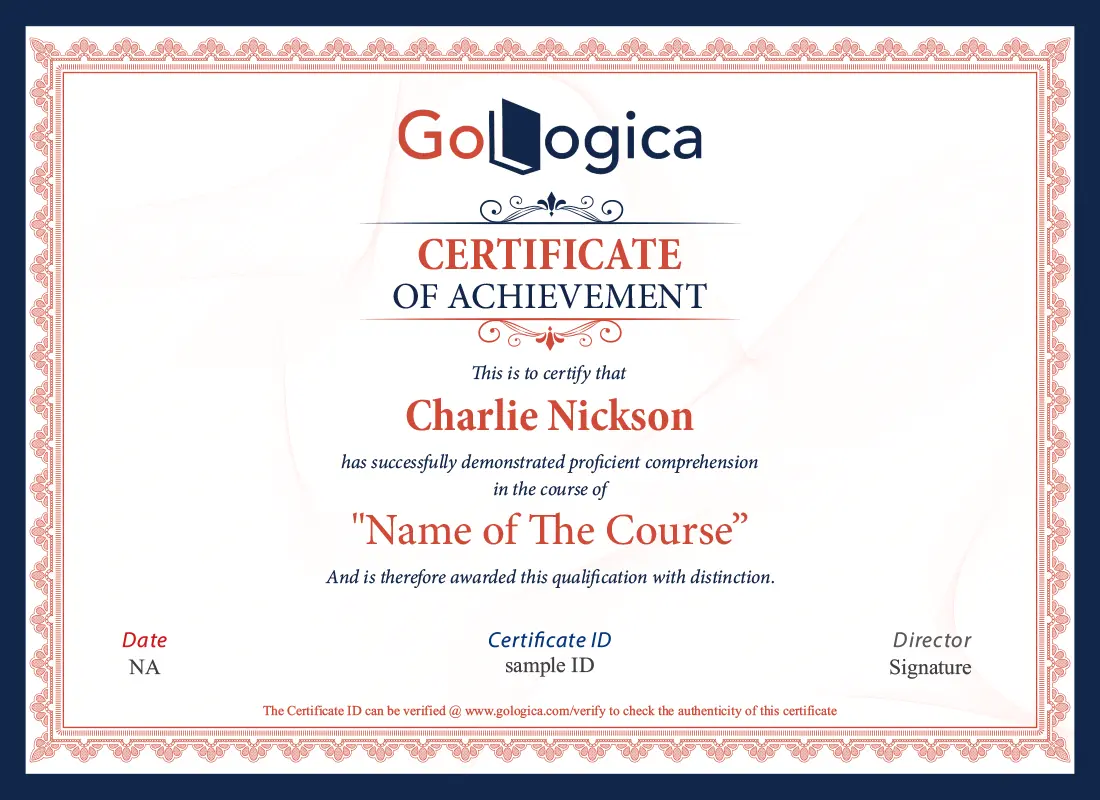
At the end of this course, you will receive a course completion certificate which certifies that you have successfully completed GoLogica training in Databricks Data Engineering with AI technology.
You will get certified in Databricks Data Engineering with AI by clearing the online examination with a minimum score of 70%.
Get Certification
Databricks Data Engineering with AI Objectives
The development, management, and optimization of data pipelines through the Databricks Lakehouse Platform.
It is being used for developing and processing the data solutions which will allow you to carry out large-scale data processing, ETL development, data analysis, machine learning processes, and lakehouse architecture.
Some topics that may be covered in this course are as follows: navigating workspace, Apache Spark, PySpark, Delta Lake, SQL, data ingestion, ETL pipelines, data transformation, workflow orchestration, and performance optimization.
Lakehouse Platform is the name for the combination of functions available in data lakes and data warehouses, along with the platform where the data is stored, processed, managed, and analyzed.
The distributed data processing engine designed to perform efficient data processing on large datasets.
PySpark is an API of Apache Spark for Python. It provides the facility to perform data processing, transformation, analysis, and scalable data pipelines using the Python language.
Delta Lake is the storage layer which ensures the ACID transactions, schema enforcement and time travel as an effort to improve the reliability of the data stored in the data lake.
A data lake is designed for storing structured, semi-structured, and unstructured data, whereas a data warehouse is for structured data only. The combination of both is termed as a data lakehouse.
Extract, transform, load, or simply ETL, refers to the process where data is extracted from the source systems, transformed, and then finally loaded into the target system.
While ETL is a process where data is transformed before being loaded into the target system, on the other hand, ELT involves loading of data and then doing transformation of the data in the target system.
Notebooks are tools that enable writing code, executing it, interacting with datasets, data transformation, documentation, and collaboration while doing data engineering jobs.
Datasets distributed over several nodes in terms of named columns are called Spark DataFrames. Structured transformations like joins, aggregations, filters, and so on can help in processing.
A collection of transformations used to transfer data from source systems to destinations is known as a data pipeline.
Data can be ingested with the help of connectors, cloud storage, files, streaming services, and others. It depends on the amount of data, its format, and the requirements of processing.
Workflow orchestration enables coordinating processes, managing dependencies, scheduling process execution, monitoring pipeline execution, and automating data processing operations.
When processing data in batches, batch processing is employed.
Data quality can be ensured through schema validations, constraint checks, deduplication of data, detecting missing values, profiling, and pipeline monitoring.
Performance optimization is required for better efficiency of processing, less waste of resources, and efficient work of pipelines with large amounts of data. Methods include partitioning, caching, and query/file management.
SQL helps in running queries, filters, joins, aggregation, and transformation on structured data. It can also help in validation and data transformation design in Databricks.
Some knowledge of Python is useful, especially when writing PySpark applications. Also, some SQL knowledge and knowledge of data engineering are useful, although they can be learned from scratch.
The course is suitable for aspiring data engineers, software developers, data analysts, database professionals, cloud engineers, and IT professionals seeking to develop modern data platform skills.
Projects can be related to designing ETL pipelines, data ingestion from cloud storage, data transformations with PySpark, Delta Lake tables, and pipeline automation.
Knowledge of databases and Python basics would be helpful. Knowledge of cloud technologies and data processing will make it easier to grasp the advanced topics.
Possible positions are Databricks Data Engineer, Data Engineer, Big Data Engineer, ETL Developer, Cloud Data Engineer, and Data Platform Engineer, among others.
Data Engineer certification proves a person's knowledge and skills in data engineering using Databricks tools.
One such certification that beginners opt for is the Databricks Certified Data Engineer Associate. You may want to review the latest exam guide to determine its relevance to you.
While the former tests the foundational knowledge of candidates in data engineering, the latter tests more advanced knowledge. Please consult the current exam guides for more details on the skills required in both credentials.
This may consist of Databricks, Apache Spark, PySpark, Delta Lake, data ingestion, transformation, data pipeline creation, and workflow management. These topics are going to vary depending on the nature and the version of the certification that you are preparing for.
Examine the official guide, practice using Databricks notebooks, create data pipelines, go over pertinent platform capabilities, and take practice tests that match the stated test objectives.
No. A candidate is not given a formal Databricks certification simply by attending training. The candidate has to fulfill the relevant requirements, and the candidate also has to pass the exam.
Why GoLogica?
10+
Years of Experience
250+
Corporate Clients
750+
Courses
50K+
Careers Transformed
Yes, it is Possible. GoLogica provides a fast-track Classes so you can complete a training within a few days or a week and get a certification.
To attend online training, you'll typically need a stable internet connection, a compatible device (laptop, tablet, or smartphone), and a suitable web browser or training software.
Check your training platform's storage or cloud (drive) for saved video recordings.
Discounts may vary; inquire directly for specific offers.
Visit GoLogica website, locate the 'Certificates' section, follow the instructions to verify your course completion by completing the exam and Get more than 70% marks. And download your certificate.
I'll guide you through the certification process step-by-step, ensuring you're well-prepared and confident in your subject matter by clearing an exam.
Yes, we help you on a Craft a compelling resume by highlighting your skills, experiences, and achievements in a clear, concise, and well-structured format.
Yes, we do placement assistance after completing a training and clearing eligibility test.
Our mock interviews process involves practice sessions, feedback, and role-playing to enhance candidates' communication skills and confidence in a concise, single-line summary:
"Practice + Feedback = Confident Interview Readiness."
The refund policy terms and conditions may vary; please refer to the specific seller or provider for details. Go to Refund Policy »
Yes, discuss payment terms with the Seles team and Get a potential instalment options.
Yes, you will find EMI options for fee payment.
Get in Touch to our team by filling a required details.
GoLogica certification holds value for those seeking to learn and validate their skills in Logic Apps all over the world.
Yes, GoLogica offers opportunities to work on live projects, enhancing your practical skills and experience.
Our trainers are highly experienced in respective Field and implementing real-time solutions on different Scenarios and Expert in their professionals.
We record each LIVE class session you undergo through this training and recordings of each session class will be updated in your Cloud.
Yes, access online course materials through learning platforms or the institutions or a GoLogica website.
GoLogica have a 10+ year’s good track record in the training market. However, it was founded in 2013.
Yes, we help you on a Craft a compelling resume by highlighting your skills, experiences, and achievements in a clear, concise, and well-structured format.
Self-paced training allows learners to study at their own speed, while Live Online training offers real-time, interactive sessions with an instructor.
Self-paced learning offers flexibility, personalized progress, and the ability to review materials at your own convenience.
Live online training offers real-time interaction, immediate feedback, and networking opportunities, which self-paced learning lacks.
Yes, GoLogica allows you to transition from self-paced to instructor-led training as per your preference T&C apply.
Yes, customize GoLogica curriculum as per your needs. Our Goal is to satisfy and give an enough knowledge to students.
Timetable flexibility depends on the institution and availability; inquire for options.
Yes, depending on program flexibility. Communicate with the organizers for options.
Consult your training contract for withdrawal terms, prioritizing mutual understanding.
Yes, we offer a Demo Session to confirm your enrolment session details for live training.
Yes, the trainer will help you with your queries during the training and as well as in discussion class.
Practice consistently, apply learned skills in real-life scenarios, and seek feedback for improvement.
Yes, we can provide trained resources for hire upon request.
Self-paced videos can be classified into beginner, intermediate, advanced, and expert levels.
Yes, we can consider extending access for pre-recorded sessions.
Yes, customizable live training allows for scheduling flexibility and tailored curriculum.
Yes, we conduct assessments and also some mock test for better understanding along with discussion call.
Yes, we offer a certification and it is highly valuable in market
Yes, you can but just Inquire about extension options post-training.
Yes, post-training consultations can be arranged upon request.
Our trainers are highly experienced in on specific subject matter to teach and uses by real-time solutions on different Scenarios and Expert in their professionals.
You can access the recording of the missed class through our LMS. We record each training session and upload it after the session to our LMS which can be accessible to the students.
You can clarify your queries by dialling +91 - 82 9696 0414, +1 (646) 586 - 2969 Or you can send a mail to info@gologica.com. We are ready to clear your enquiries at any time